
Skip to product information
1 of 13

Vintage and Antique Gifts

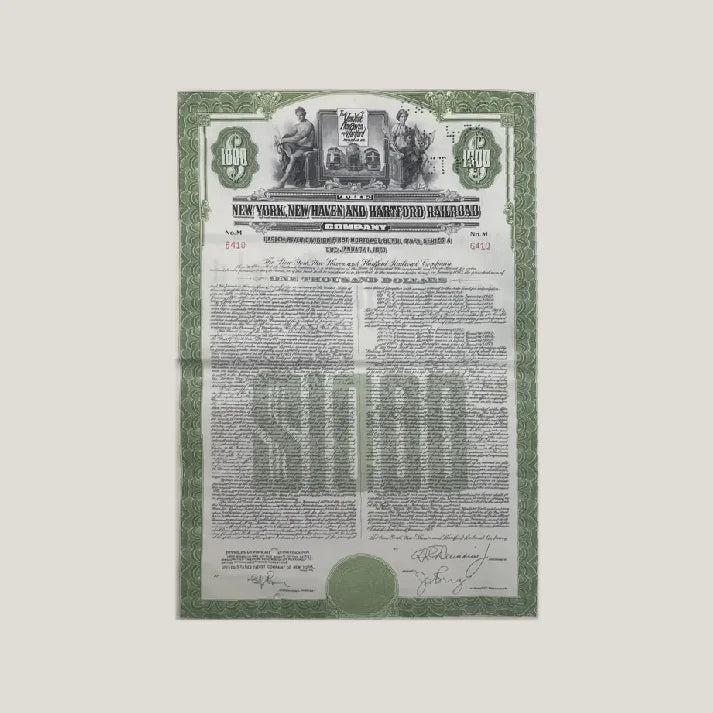
Vintage Mid-Century New York, New Haven & Hartford Railroad Bond 🚂 $1000 Harlem River Division Mortgage w/ Coupons

Regular price 15.00 USD
Regular price Sale price 15.00 USD
Sale Sold out
Shipping calculated at checkout.

Description

Ever wonder what a piece of New England's rail empire actually looked like on paper? 🚂

Long before Amtrak, before Metro-North, before anyone had heard the words "Northeast Corridor," there was simply "the New Haven" — the railroad that stitched Boston to New York City and every mill town, shore village, and commuter platform in between. This bond is a genuine surviving piece of that story: a $1,000 corporate promise printed at the height of mid-century American railroading, backed by a real mortgage on real New York trackage, and dressed in the kind of engraved artistry that financial printers reserved for documents meant to be trusted at a glance. If you've ever caught yourself slowing down at an old estate sale table full of stock certificates, wondering what stories are folded up inside them — this one has an unusually good story to tell.

This is a New York, New Haven and Hartford Railroad Company $1,000 Harlem River Division First Mortgage Bond, Series A, engraved and issued out of the railroad's New York offices, with its printed date reading January 1, 1953 and a printed maturity of January 1, 1973. It's a large-format certificate, measuring roughly 15 x 10 inches, printed in the classic bank-note palette of deep green, black, and cream, with the denomination lettered boldly in stylized "$1000" cartouches at both upper corners and a serial number stamped in red ink. Across the top, a central engraved vignette shows a toga-draped young man seated at left with a slender branch across his knee, and a laureled woman at right holding sheaves of wheat and a horn of plenty, flanking a framed scene of paired mid-century diesel locomotives meeting nose to nose on parallel tracks beneath a banner reading "The New York, New Haven and Hartford Railroad Co." Fine-line guilloche scrollwork frames the entire document, and a run of attached interest coupons — each one a small engraved panel bearing its own classical profile bust and a face value of $21.25, representing the semi-annual payment on the bond's 4¼% rate — lines the edge, giving the whole certificate the tactile, layered look that scripophily collectors prize. This is a genuine issued bond, punch-cancelled through the vignette when it was retired and preserved ever since.


🏛️ The New Haven: From Connecticut Merger to New England's Rail Colossus

The company behind this bond traces to July 24, 1872, when the Hartford and New Haven Railroad merged with the New York and New Haven Railroad — a union the Connecticut legislature had actually rejected two years earlier over fears of an unchecked monopoly, before finally approving it. From that Connecticut root, the New Haven grew into what was, for decades, the largest and most important transportation enterprise in New England, running both freight and passenger service across New York, Connecticut, Rhode Island, and Massachusetts.

The real empire-building began around the turn of the century, when New York financier J.P. Morgan set his sights on monopolizing New England transportation. Under his direction and with Charles S. Mellen installed as president in 1903, the railroad swallowed roughly 50 companies — competing railroads, steamship lines, and an entire electrified trolley network — until by 1912 the New Haven controlled more than 2,000 miles of track and employed some 120,000 people, holding what amounted to a stranglehold on traffic between Boston and New York. It was an extraordinary run of consolidation, and it came at an extraordinary price: the company's debt ballooned from $14 million in 1903 to $242 million in 1913. A 1907 investigation led by Louis Brandeis — years before his appointment to the U.S. Supreme Court — found the railroad dangerously overextended, and when Morgan died in 1913 and Mellen resigned soon after, the New Haven's empire began to come apart. Federal antitrust action in 1914 forced the railroad to divest its trolley holdings, and the company survived World War I only because the U.S. Railroad Administration took over its operation entirely.

A measure of stability returned in the 1920s under president Edward Pearson, who formed a motor-coach subsidiary, the New England Transportation Company, to meet the rising challenge of the automobile. But the Depression cut that recovery short, and in 1935 the New Haven plunged into bankruptcy — a trusteeship that would last twelve years.


💵 A Bond Born in a Fragile Recovery

The New Haven finally emerged from that first bankruptcy in 1947, buoyed by wartime traffic, and in 1948 financier Frederic C. Dumaine, Sr. took the controls and pushed through an aggressive cost-cutting regime, reportedly dismissing every employee earning over $10,000 a year. This bond's printed date of January 1, 1953 falls squarely inside that austerity-driven Dumaine era — a company trying to prove, on paper at least, that it had steadied itself. Investors buying Harlem River Division mortgage bonds in 1953 were betting on a railroad that looked, for the moment, like it had turned a corner.

That confidence didn't last. By the early 1950s both freight and passenger revenue were sliding again, and a string of hurricanes and flooding in 1954 and 1955 tore into the railroad's already thin finances. The 1958 opening of the Connecticut Turnpike pulled still more traffic onto the highways. In 1959 the New Haven discontinued its Old Colony passenger service after Massachusetts refused to keep subsidizing it, closing the year with close to $11 million in losses, and by February 1960 the company's own comptroller was telling regulators, in effect, that the railroad's survival was in doubt no matter how well it was managed. The bond in your hands, in other words, was issued at the exact hinge point between recovery and collapse.


⚖️ Second Bankruptcy, Penn Central, and the Long Road to Conrail

On July 7, 1961, the New York, New Haven & Hartford filed a second federal reorganization petition — a court would later describe the railroad plainly as "a financially derailed and wrecked" enterprise, its current liabilities exceeding current assets by more than $36 million and cash losses running near $18 million a year. Judge Robert P. Anderson presided over what became a seventeen-year reorganization saga. A trusteeship ran for seven of those years before the New Haven was finally absorbed into the Penn Central system on January 1, 1969 — only for Penn Central itself to collapse into bankruptcy barely three years later, in one of the largest corporate failures in American history to that point. The New Haven's freight lines eventually passed into the government-created Conrail system in 1976, and the very last chapter of the reorganization closed on August 28, 1980, when American Financial Enterprises, Inc. acquired what remained, bringing the storied 108-year corporate life of "the New Haven" — and its second, nineteen-year bankruptcy odyssey — to its final close.


🌉 The Harlem River Division: A Bronx-to-New Rochelle Story

The specific mortgage securing this bond traces to one of the New Haven's very earliest acquisitions: the Harlem River and Port Chester Railroad, chartered in 1866 and leased by the New Haven on October 1, 1873 — reportedly the New Haven's first lease after its own 1872 formation. For decades this line ran quietly as a branch route linking New Rochelle, New York, down through the Bronx. Everything changed in 1916, when the newly built Hell Gate Bridge and the New York Connecting Railroad transformed the Harlem River Branch from a minor local spur into a vital through route, giving New England direct rail access into Manhattan's Penn Station via the Pennsylvania Railroad system for the first time.

Federal bankruptcy court records from the New Haven's later reorganization independently confirm details that match this bond precisely: the United States Trust Company of New York served as trustee of the Harlem River Division bonds, the mortgage was fully secured and relatively modest in size — on the order of $6.6 million outstanding — and its maturity fell in January 1973, exactly matching the due date printed on this certificate. Court records even show that Harlem River bondholders were a live legal question during the 1969 Penn Central merger, as the reorganization court weighed whether Penn Central would assume this very mortgage — meaning bonds of this series were still an active piece of railroad finance a full fifteen years after they were first issued, right through the New Haven's final collapse.


🖋️ The Engraver's Hand

This bond was engraved by the Columbian Bank Note Company, one of the security printing houses of the era that specialized in the fine intaglio engraving trade — stocks, bonds, checks, and other financial instruments demanded printing that was beautiful precisely because it was nearly impossible to counterfeit. That's the tradition this certificate belongs to: the same guilloche border work, allegorical vignettes, and raised-seal authentication used on currency itself, applied here to a railroad's promise to repay a thousand dollars twenty years down the line.


👥 The Men Behind the Empire — and the Reckoning

Every era of the New Haven's history has its own outsized personality. There's J.P. Morgan, the Gilded Age financier chasing regional monopoly with a buyer's appetite that outran the railroad's ability to pay for it. There's Charles Mellen, the president Morgan installed to execute that vision, who resigned in the wreckage once the debt crisis became public. There's Louis Brandeis, the reform-minded lawyer whose 1907 investigation into the New Haven's finances helped cement his reputation as a champion against corporate overreach years before he took his seat on the Supreme Court. And there's Frederic C. Dumaine, Sr., the cost-cutting industrialist who took the reins in 1948 and, through sheer austerity, bought the railroad just enough breathing room to issue bonds like this one in the early 1950s before the deeper structural problems of postwar American railroading caught up with it anyway.


🚋 Old-Timers Recall: Riding the New Haven Line

Collectors and rail historians alike still talk about the New Haven's electrified main line — one of the earliest large-scale mainline electrifications undertaken by any American railroad, strung with overhead catenary that let sleek electric locomotives glide commuters and long-distance travelers alike toward Grand Central Terminal. Old-timers along the shoreline recall named trains like the Merchants Limited and the Yankee Clipper linking Boston and New York in high style, and generations of Connecticut and Westchester commuters built their daily routines around the New Haven's timetable long before anyone called it Metro-North. Lore passed down among railroad enthusiasts holds that few American railroads packed so much drama — monopoly ambition, financial collapse, federal rescue, and reinvention — into a single corporate lifetime, and that reputation is a large part of why New Haven paper has stayed so collectible long after the company itself disappeared.


🛤️ The Impact Today

The rails behind this very mortgage never disappeared — they simply changed hands and purpose. The New Rochelle–to–Bronx corridor once secured by the Harlem River Division bonds still carries commuter trains today as part of the Metro-North Railroad system feeding into Grand Central Terminal, a living, working descendant of the New Haven's original network. The bond itself, meanwhile, has taken on a second life entirely apart from railroading: once a company like the New Haven dissolves for good, as it finally did in 1980, its stock and bond certificates stop being financial instruments and become historical ones — the hobby collectors call scripophily. Pieces like this, with their engraved vignettes, coupon sheets, and trustee seals, are sought after today not for redemption value but as tangible, framable fragments of American corporate and rail history.

Coupons were made to be clipped away, and most bonds of this age lost theirs one payment at a time until only the certificate was left, so a sheet that came through the decades still attached is the exception rather than the rule. When a road went under, holders commonly taped the last coupon back onto the bond and held on in hope of collecting what they were owed, so a bond that still carries that taped final coupon is the better one to end up with. The coupon count can run a few more or a few fewer than what is pictured.


🖼️ Display Ideas

  • 🚂 Framed solo as a statement piece in a home office, den, or dedicated train room
  • 🗺️ Paired with vintage New Haven timetables, route maps, or station photographs for a themed rail history wall
  • 🏙️ Grouped with other New York or New England financial ephemera for a Gilded Age–to–mid-century Wall Street display
  • 🎟️ Displayed alongside old commuter tickets or postcards of Grand Central Terminal for a New England commuter-history vignette
  • 📚 Shown open-faced in a shadow box so the coupon sheet and engraved vignette are both visible at once
  • 🎁 Given as a milestone gift to a railroad enthusiast, Connecticut or New York native, or finance history buff

🎁 Who Collects These

This bond speaks to several overlapping collector interests at once: scripophily collectors who build portfolios of historic stock and bond certificates for their engraving quality and company history; railroad history enthusiasts and model railroaders drawn to anything tied to a named, storied line like the New Haven; New England natives and Connecticut/New York commuters with a personal connection to the routes this railroad once ran; and collectors of American financial and banknote-

These are issued instruments rather than blanks. Bonds and debentures of this type were registered to a holder, authenticated by the trustee, and punch- or cut-cancelled when they were finally redeemed. Expect financial writings, markings, stamps, hole punches and staple holes as part of the life of the instrument: endorsements and signatures, trustee and registrar stamps, revenue or documentary tax stamps, cancellation punches, staple holes from being bound into a transfer book, pencil ledger notations. That is the paper trail of a security that actually did its job, and it is what separates a document that lived from a blank that never did. No two are alike: holder details, serial numbers, dates, signatures, stamps and punch patterns vary from example to example, so the photographs show the type rather than the exact sheet that ships. The coupon count can run a few more or a few fewer than pictured.

Shipping

🚚 Shipping & Handling

  • Shipping costs and timing are calculated at checkout.
  • Items curated and shipped directly by me include U.S. shipping at no additional cost, professionally packed to ensure safe arrival of your artifact.

Items from Vetted Pro Collectors
Shipping for items offered by vetted Pro Collectors is determined at checkout. All Pro Collector listings are reviewed to ensure fair, reasonable shipping practices.

For full details, please refer to our Shipping Policy.

Returns & Exchange

Product Page Return Policy

  • 60-Day Returns – Items must be in original condition.
  • Refunds – Issued after inspection (excluding shipping costs).
  • Return Shipping – Customer is responsible unless item is damaged or incorrect.
  • Damaged/Incorrect Items – Contact us within 48 hours for a replacement or refund.
  • Easy Returns – Email [email protected] or call 802-356-9872 to initiate a return.

For full details, visit our Refund Policy.

View full details