Skip to product information
1 of 8

Vintage and Antique Gifts

Antique 1898 New York Central & Hudson River Railroad Gold Bond 🚂 Lake Shore Collateral Certificate

Regular price 35.00 USD
Regular price Sale price 35.00 USD
Sale Sold out
Shipping calculated at checkout.

Description

What Would It Feel Like to Hold a Hundred-Year Promise, Payable in Gold? 🚂

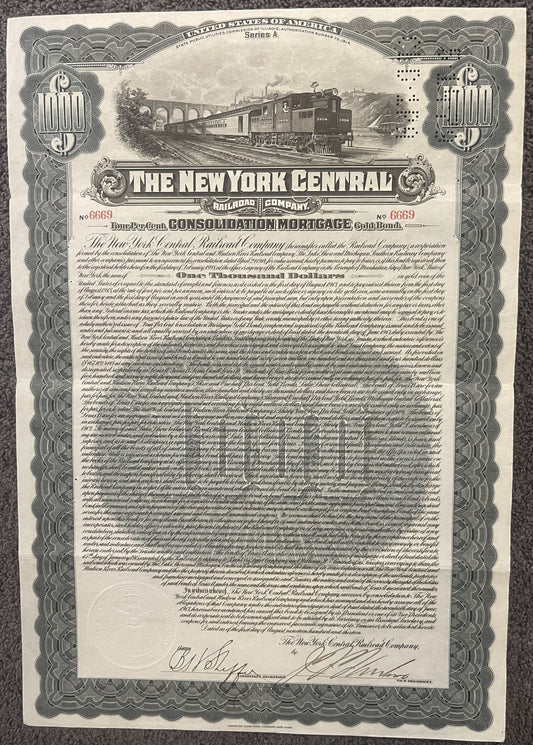
There's a particular kind of thrill in unfolding a document like this one — heavy cream stock, dense with engraved script, a wood-burning locomotive barreling toward a harbor crowded with tall ships and a smoke-stacked warehouse along the top of the page. This is the kind of paper that once represented real money, real risk, and real faith in the biggest industrial machine 19th-century America ever built: the railroad. A bond like this was, quite literally, a promise payable in gold coin — secured by shares of another great railroad, and struck into being at the height of the Gilded Age, when the men who ran America's rail lines were also, quietly, some of the most powerful men in the country.

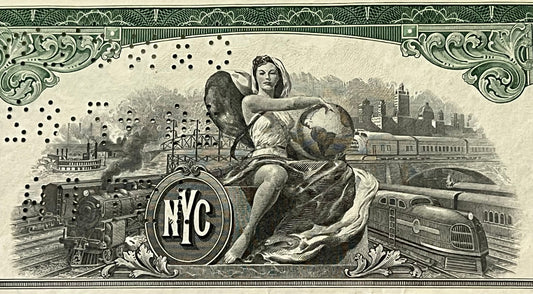
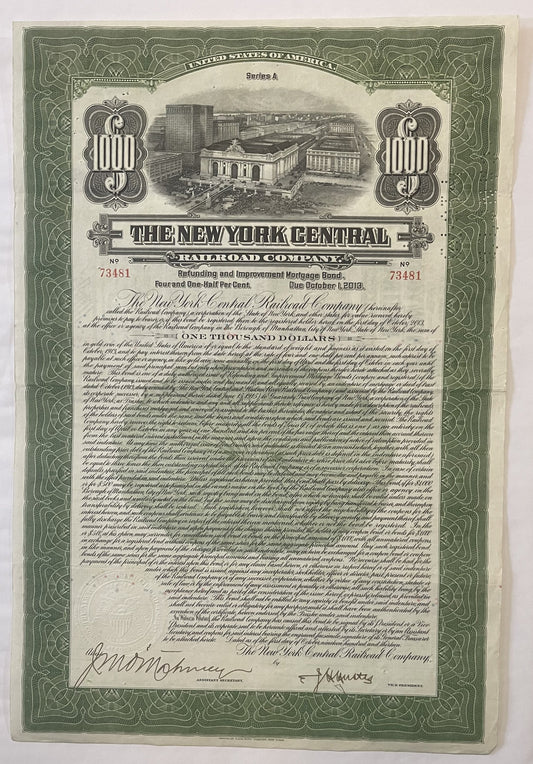
This is an authentic $1,000 gold bond issued by The New York Central and Hudson River Railroad Company of New York, N.Y., part of a "Three and One-Half Per Cent. Coupon Gold Bond" series known formally as the Lake Shore Collateral issue. Certificates in this series carry a printed execution date of February 4, 1898, and a printed maturity date exactly a century later, February 1, 1998 — a genuine hundred-year bond. Each certificate measures a substantial 15" x 10" and is accompanied by its long run of attached semi-annual gold coupons — small tear-off promises of interest, each one meant to be clipped and redeemed, decades apart, right on down the line. The artwork is a hallmark of the era: an engraved arch framing that locomotive and boxcar rolling past a harbor of steamships and sailing vessels beside a warehouse, wrapped in the elaborate green-and-black lathework borders and ornamental script lettering that only the finest security printers of the day could produce, with the identifying numbers picked out in red. It is a genuine piece of Gilded Age railroad Americana — the kind of thing meant to be framed, studied, and told and retold.


🚂 The Vanderbilt Railroad Behind the Name

The company named across the top of this bond didn't start out as a giant — it started as a portage line. The earliest ancestor of the New York Central was the Mohawk and Hudson Railroad, chartered in 1826 to connect the Mohawk River at Schenectady to the Hudson River at Albany, so that freight and passengers could bypass the slow lock-work of the Erie Canal. It opened in 1831, one of the very first railroads in the United States, and it worked: what had taken a full day by canal took less than an hour by rail. In 1853, Albany businessman and mayor Erastus Corning merged ten of these small New York State lines into a single New York Central Railroad running from Albany to Buffalo. The man who turned that regional line into an empire came from the water, not the rails. Cornelius Vanderbilt made his name and his fortune running steamships and schooners on the Hudson before he ever owned a mile of track — which makes it fitting that the railroad bearing his stamp is remembered today for hugging the very river he once sailed. Vanderbilt took control of the Albany-to-Buffalo New York Central in 1867, and on November 1, 1869, merged it with his Hudson River Railroad to form The New York Central and Hudson River Railroad Company — the exact corporate name printed on this bond — extending the line south along the Hudson's east bank all the way into New York City. That same year, the New York State Legislature folded in Vanderbilt's Midwestern holdings as well, including a line called the Lake Shore and Michigan Southern Railway — the very railroad whose stock, twenty-nine years later, would give this bond its name.


💰 The Deal This Bond Actually Paid For

This series of bonds wasn't raised to lay new track or buy locomotives — it financed a corporate takeover, and a well-documented one at that. In early 1898, the New York Central's board authorized the outright purchase of the entire capital stock of the Lake Shore & Michigan Southern Railway Company, a $50,000,000 holding, and agreed to pay for it by issuing $100,000,000 in these very gold bonds — one $1,000 bond for every five shares of Lake Shore stock acquired. The Lake Shore stock itself was then deposited with the Guaranty Trust Company of New York as trustee, pledged as collateral security behind the bonds — which is exactly why "Lake Shore Collateral" is printed across the certificate. By the middle of that year, nearly $90,000,000 of these bonds had already been issued in exchange for stock, in a company absorption that was very much still unfolding as the ink dried.

1898 was, by coincidence, also a year of real upheaval in the railroad's boardroom. Cornelius Vanderbilt II, grandson of the Commodore and the family's standard-bearer at the head of the New York Central, had suffered a paralytic stroke back in 1896 and had been forced to step back from active management; in April of 1898 he formally retired as chairman, and Samuel R. Callaway — the sitting president of the Lake Shore & Michigan Southern, the very railroad this bond was buying out — was chosen to take the New York Central's presidency in his place. The company's own annual report for the year also records the deaths of directors Erastus Corning Jr. and George C. Buell, the retirement of longtime Third Vice-President H. Walter Webb due to illness, and the retirement of General Manager John M. Toucey after forty-three years of service. A bond dated February 4, 1898 was, in other words, issued in the exact year the Vanderbilt family's own figurehead was forced by illness to hand the railroad over to a new generation of management.

The word "gold" printed across this bond is worth pausing on, too. The 1890s had just put the American gold standard through its worst stress test in a generation — the Panic of 1893 had drained the U.S. Treasury's gold reserves and sent investors scrambling to convert paper assets into gold coin, fearful the country would be forced off the standard entirely. A railroad issuing a fresh hundred-year bond in 1898, explicitly "payable in gold coin of the United States," was making a direct and very current promise to nervous investors — American and foreign alike — that this particular obligation would hold its value no matter which way the era's heated currency politics went.


🌊 The Water Level Route

The "Hudson River" half of this railroad's name describes real, celebrated civil engineering, not just a scenic backdrop. In 1847, engineer John B. Jervis surveyed a rail line along the Hudson's east bank that would become the Hudson River Railroad, following what is still considered the only water-level break in the entire Appalachian mountain chain. The line opened in stages — Chambers Street in Lower Manhattan to Peekskill in 1849, on to Poughkeepsie by year's end, and the full run to Albany completed in 1851 — and it was Vanderbilt's own 1866 bridge across the Hudson at Albany that finally tied the whole system together and made the line profitable, setting up his takeover of both companies the following year.

Railroad men of the era were fiercely proud of what that flat corridor meant competitively. While the Pennsylvania Railroad, the Baltimore & Ohio, and the Chesapeake & Ohio were forced to blast tunnels and claw their way over the steep grades of the Appalachians, the New York Central rode the natural, level path carved by the Hudson River, the Mohawk Valley, and the shores of the Great Lakes clear through to Chicago — earning the whole system its enduring nickname, the "Water Level Route." Lower grades meant faster trains, lighter locomotives, and lower costs than any mountain-climbing rival could match — a genuine engineering and business advantage the Central bragged about for the better part of a century.


🖋️ The Engraver's Craft Behind the Paper

The security printing on a bond like this one is its own quiet piece of American craft history. Certificates of this style were the work of the American Bank Note Company of New York, a firm formed in 1858 when seven of the country's largest engraving houses — among them Toppan, Carpenter & Co. and Rawdon, Wright, Hatch & Edson — merged in the aftermath of the Panic of 1857, banding together to fight the rampant counterfeiting that plagued America's patchwork of bank-issued currencies. That same firm had, a few years later, given American paper money its enduring nickname: the reverse of the Civil War-era Demand Notes and United States Notes was printed in the company's own patented green ink, prized for resisting counterfeiters — and it's the origin of the term "greenbacks" we still use today. In an era when the New York Stock Exchange required all listed certificates be engraved by a "responsible" security printer, this was one of the very firms that rule was written around — which is exactly the kind of trusted hand behind the dense lathework, script lettering, and locomotive vignette engraved across this certificate.


📉 What Became of the Railroad

The Lake Shore & Michigan Southern stock this bond helped purchase was itself folded into a reorganized New York Central Railroad in 1914. The larger system it belonged to went on to become one of the two dominant railroads of the American Northeast, until the postwar decline of passenger rail — squeezed by the rise of the automobile and the airplane — pushed the New York Central into a 1968 merger with its old rival, the Pennsylvania Railroad, forming Penn Central. The combined company lasted barely two years before collapsing into what was then the largest bankruptcy filing in American history, a wreck eventually absorbed by the federally chartered Conrail. It's a genuinely remarkable arc to hold in one hand — a hundred-year bond, printed in the full confidence of the Gilded Age, issued by a company that wouldn't survive to see even its own maturity date.


🖼️ Display Ideas

  • 🖼️ Framed alone under glass, letting the engraved locomotive-and-harbor vignette take center stage in a study or office
  • 🚂 Paired with other railroad ephemera in a themed shadow box for a den, depot museum, or model train room
  • 🏛️ Matted with a short typed card noting the Vanderbilt / Lake Shore history, for a library or history-buff's wall
  • 🎁 Given as a gift to a railroad enthusiast, financial history collector, or anyone with ties to the Hudson Valley or upstate New York
  • 💼 Displayed on a desk or bookshelf easel as a conversation piece for anyone in finance, banking, or corporate history

🎁 Who Collects These

Scripophily collectors — people who collect antique stocks and bonds as an art form in their own right — are the natural home for a piece like this, alongside railroad history buffs, Hudson Valley and upstate New York collectors, and anyone drawn to Gilded Age Americana or the Vanderbilt story specifically. It's also a favorite for depot museums, railroad societies, and gifts for the "railroad guy" in the family who already has the model trains and the timetables but not a genuine piece of the paper trail behind them.


❓ FAQ

What exactly is this document?

It's a $1,000 gold-coupon bond issued by The New York Central and Hudson River Railroad Company, part of the "Lake Shore Collateral" series dated February 4, 1898, secured by that railroad's holdings in the Lake Shore & Michigan Southern Railway.

How big is it?

Certificates in this series measure 15" x 10", complete with the attached run of semi-annual gold interest coupons.

Was this bond ever actually paid out in gold?

The bond promises repayment of principal and semi-annual interest in United States gold coin, per its printed terms — it was structured as a genuine hundred-year obligation, with a printed maturity date of February 1, 1998.

Who printed it?

The engraving is the work of the American Bank Note Company of New York, the same security-printing house responsible for the green ink that gave Civil War currency the nickname "greenbacks."

What was the Lake Shore Collateral about?

In 1898, the New York Central's board used this $100,000,000 bond series to pay for its outright purchase of the Lake Shore & Michigan Southern Railway's capital stock, pledging that same stock as collateral behind the bonds.

Is this connected to Cornelius Vanderbilt?

Yes — the New York Central and Hudson River Railroad was formed in 1869 by Cornelius Vanderbilt's merger of the New York Central Railroad with his own Hudson River Railroad, and the Lake Shore & Michigan Southern named on this bond was one of his Midwestern holdings folded into the same system that same year.

Does it come with the coupons attached?

Certificates of this type include their long printed run of attached semi-annual gold coupons as issued.

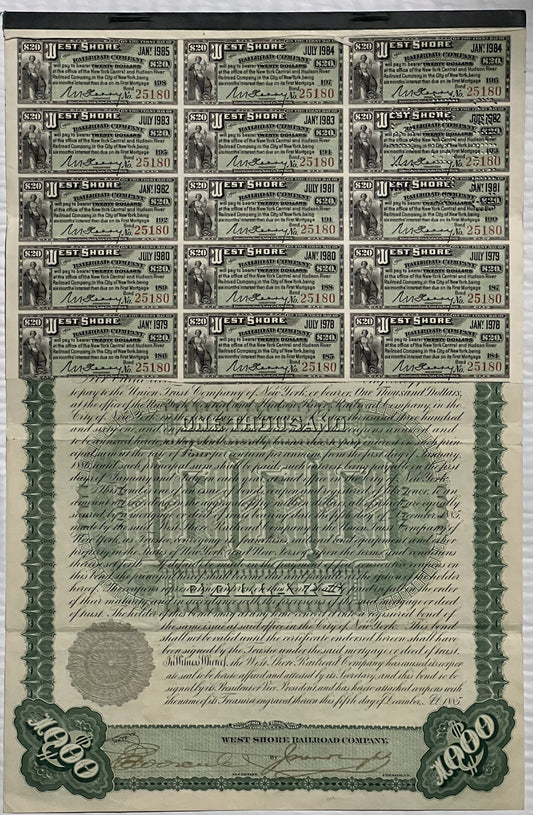
Coupons were made to be clipped away, and most bonds of this age lost theirs one payment at a time until only the certificate was left, so a sheet that came through the decades still attached is the exception rather than the rule. When a road went under, holders commonly taped the last coupon back onto the bond and held on in hope of collecting what they were owed, so a bond that still carries that taped final coupon is the better one to end up with. The coupon count can run a few more or a few fewer than what is pictured.

An issued certificate picks up the marks of its working life: endorsements and signatures on the reverse, transfer-agent and registrar stamps, revenue or documentary tax stamps, punch or cut cancellations at redemption, staple holes from being bound into a transfer book, and pencil ledger notations. Those marks are the paper trail of a financial instrument that actually did its job.

Shipping

🚚 Shipping & Handling

  • Shipping costs and timing are calculated at checkout.
  • Items curated and shipped directly by me include U.S. shipping at no additional cost, professionally packed to ensure safe arrival of your artifact.

Items from Vetted Pro Collectors
Shipping for items offered by vetted Pro Collectors is determined at checkout. All Pro Collector listings are reviewed to ensure fair, reasonable shipping practices.

For full details, please refer to our Shipping Policy.

Returns & Exchange

Product Page Return Policy

  • 60-Day Returns – Items must be in original condition.
  • Refunds – Issued after inspection (excluding shipping costs).
  • Return Shipping – Customer is responsible unless item is damaged or incorrect.
  • Damaged/Incorrect Items – Contact us within 48 hours for a replacement or refund.
  • Easy Returns – Email [email protected] or call 802-356-9872 to initiate a return.

For full details, visit our Refund Policy.

View full details