Skip to product information
1 of 4

Vintage and Antique Gifts

Antique 1910s Carbolic Acid Poison Label ☠ Graham & Wortham's Drug Store, Corvallis OR

Regular price 13.00 USD
Regular price Sale price 13.00 USD
Sale Sold out
Shipping calculated at checkout.

Description

☠ A Complete Household Emergency Protocol, Printed on One Sheet

This is an original, unused carbolic acid poison label from Graham & Wortham's Drug Store of Corvallis, Oregon. It is a genuinely large-format druggist's label, printed in a single orange-red ink on pale grey-green stock, and it carries something most bottle labels of its era did not: a complete, plain-English emergency antidote protocol, printed directly on the label itself. Every physical detail described here is read directly from the sheet; every historical claim is drawn from documented Benton County newspaper and pharmacy records.


📋 Reading the Label

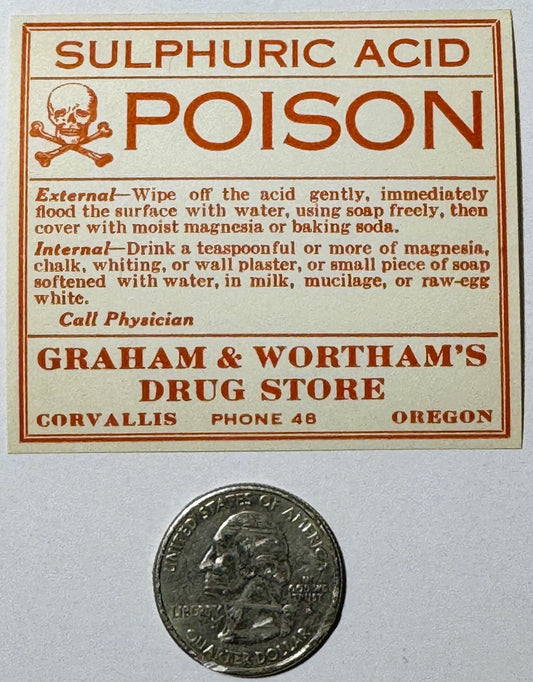
The design is arranged in three stacked panels inside a double rule. At the top, the substance name. Below it, a skull-and-crossbones device beside the word "POISON" in large letters. Below that, the antidote text, and at the foot, the pharmacy's own imprint. Every word is transcribed here verbatim: CARBOLIC ACID / POISON (with skull-and-crossbones device) / "External-Flood with water and bathe with dilute alcohol or whiskey, or a bland oil (olive, cottonseed, linseed)." / "Internal-Give milk, raw-egg white, mucilage, gruel, or cornstarch paste, and follow with an emetic (tablespoonful of mustard in a tumbler of warm water)." / "Call Physician." / GRAHAM & WORTHAM'S / DRUG STORE / CORVALLIS   PHONE 48   OREGON


💀 Why This Label Reads the Way It Does

Carbolic acid -- phenol -- is the substance that made antiseptic surgery possible after Joseph Lister, and it was also one of the great household killers of its era. It was sold over the counter by every drugstore as a disinfectant and wash, it was corrosive enough to destroy tissue on contact, and accidental or deliberate poisoning from it was common enough that carbolic acid poisoning has its own long shelf in the coroner's literature of the period. That is exactly why this label exists in the form it does: the antidote is printed directly on the container, in plain English, because in the early 1900s there was no poison control number to call, and the nearest doctor might be an hour away.

Read the antidote closely and the period opens up. "Bathe with dilute alcohol or whiskey" for external exposure. "Raw-egg white, mucilage, gruel, or cornstarch paste" internally -- demulcents meant to coat and protect the gut. "A tablespoonful of mustard in a tumbler of warm water" to induce vomiting. Then, last, almost as an afterthought: "Call Physician." It is a complete emergency protocol for a household, printed on a label, in exactly the order a frightened person would actually need it.


📍 Corvallis, Oregon -- A Real, Documented Drugstore

Graham & Wortham are documented as working druggists in Corvallis, Benton County, Oregon, in the pages of the Corvallis Gazette. The paper's issue of May 29, 1906 carries a period liniment advertisement ending "Sold by Graham & Wortham," and a separate advertisement from around 1901 for a period patent cure also names the firm; the store additionally served as a newspaper transfer point in the early 1900s. That documents the firm in Corvallis across the early 1900s -- it does not, on its own, date this specific label. The label's own second, independent dating clue is the printed "PHONE 48": a bare two-digit telephone number belongs to a small manual exchange, which in a town the size of Corvallis places it in the first quarter of the twentieth century. Taken together, the live "1910s" dating is consistent and defensible, with "c.1900s-1910s" as the most honest full range.

Corvallis is a Willamette Valley college town, home to what is now Oregon State University, and Graham & Wortham's was one of its main-street drugstores -- a small business woven into the daily life of an early-1900s Oregon town, right down to its own four-digit-free, two-digit telephone number that a local operator would have known on sight.


📏 A Genuinely Large Druggist's Label

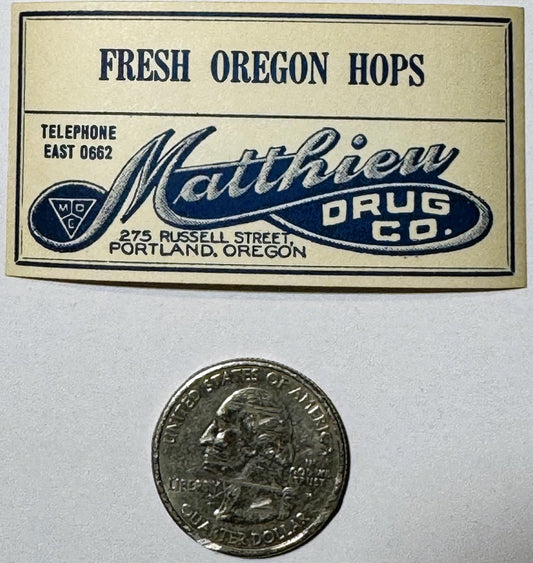
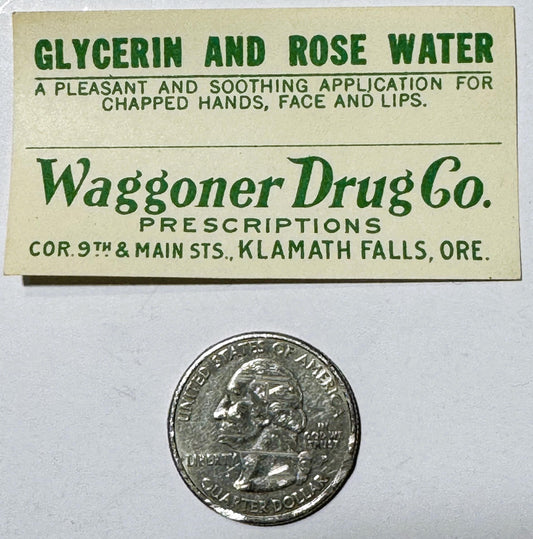
This label is notably large for its class. The photographs include a US quarter placed for scale, and working from that coin's known diameter, this label measures roughly 4 1/2 inches wide by 3 3/4 inches tall -- several times the area of the common small bottle-label format, which typically runs closer to 2 1/2 x 1 3/4 inches. That is offered here as a photo-derived estimate, not a ruler-confirmed fact, but it is a genuine and real feature of this specific label: most poison labels on the market are small, generic, and sold in undifferentiated lots, while this one is large-format, prints a complete antidote protocol, and names a specific, documented drugstore in a specific town.

That size difference is not incidental to the design -- a label meant to sit on a large carboy or dispensing bottle behind a pharmacist's counter needed room for the full antidote text to remain legible at arm's length, which a small 2 1/2 x 1 3/4 inch retail bottle label simply could not accommodate. The larger format is a functional clue to how and where this label was actually meant to be used, not just a decorative choice.


🎨 Why Orange-Red, and Why That Skull

The choice of a single orange-red ink was not decorative -- it was functional. A poison label needed to be spotted instantly on a crowded, dimly lit drugstore shelf, and a bright warning color paired with a bold skull-and-crossbones device was the period's answer to a problem modern child-proof caps and barcode scanning solve differently today. The double rule framing the whole design keeps the panel visually contained, so a glance at the shelf reads "danger" before a single word is consciously parsed.


📞 A Small Town on One Piece of Paper

"PHONE 48" is a small detail carrying real weight. A two-digit telephone number meant an operator on a manual exchange likely knew this store by name and number both -- there was no dialing a ten-digit sequence, just picking up the earpiece and asking for "48." That kind of granular, small-town telephone intimacy is a genuinely evocative detail preserved on an object that otherwise exists purely to warn about a dangerous chemical.


🔍 Condition -- Unused, Never Bottled

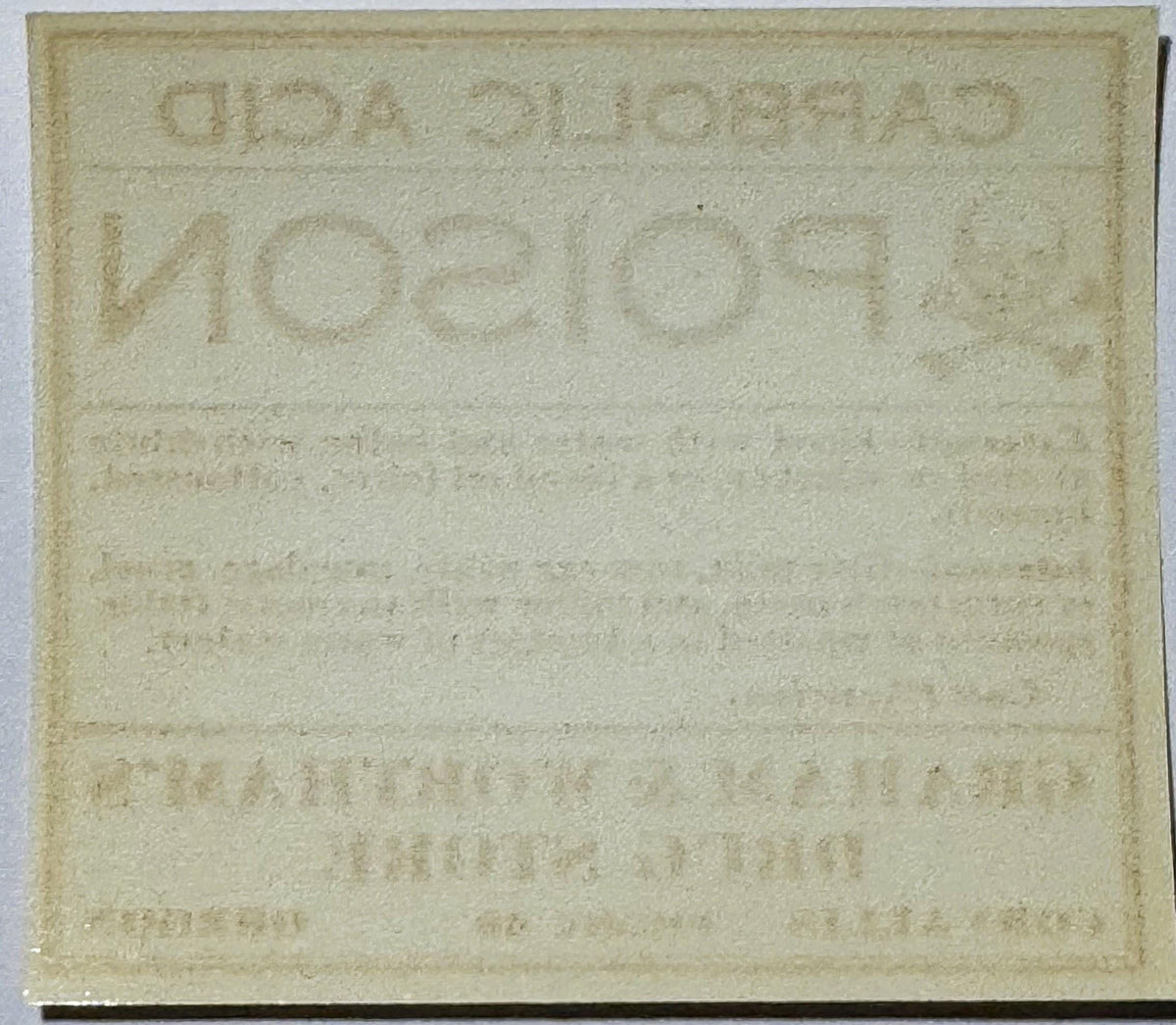
This label is unused stock, and the photographs prove it: the verso is a clean, blank sheet showing only the mirrored ghost of the front-side printing, with no gum, no paste, no bottle ring, no soiling, and square corners throughout. It was printed for the store's own dispensing counter and never applied to a bottle.


🖼️ Display Ideas

  • ☠ Frame it as a striking single piece of pharmacy history -- the orange-red ink and skull device read boldly at a distance.
  • 💊 Pair it with other early-20th-century druggist and pharmacy ephemera for a themed apothecary collection.
  • 📍 Group it with other Corvallis or Willamette Valley regional history pieces.
  • 🎁 Give it to a pharmacy history enthusiast, a medical professional, or a collector of Americana warning labels.
  • 🖋️ Store it flat in an archival sleeve if preservation matters more than display.

🎁 Who Collects Labels Like This

  • 💀 Poison label and pharmacy-warning ephemera collectors.
  • 💊 Druggist and apothecary history collectors.
  • 📍 Oregon and Willamette Valley regional history collectors.
  • 🏥 Medical and pharmaceutical history enthusiasts.
  • 🎁 Gift-givers seeking a genuinely striking, honestly documented piece of Americana.

🏭 Class Purity Note

This is a single named-pharmacy poison label -- not a poison bottle, and not one of the small generic multi-label lots that dominate this collecting category. It should never be compared against bottle pricing, an entirely different object class, or against undifferentiated small-label lots, a different sub-class of the paper poison-label market.


❓ Honest Answers

Was this label ever applied to a bottle or container?

No. The clean, blank verso with no gum, paste, or bottle ring, and its square, unworn corners, show it was printed and genuinely never used.

Who actually printed this label?

No printer's imprint is legible anywhere on the sheet, so none is claimed here.

What do we actually know about Graham and Wortham themselves?

Documented sources establish the firm -- Graham & Wortham's Drug Store -- as operating in Corvallis in the early 1900s. No first names, personal dates, or biographies of the two men are claimed anywhere in this listing, because the sources establish the business, not the individuals behind it.

How large is this label, exactly, in inches?

Not independently measured with a ruler. A coin placed in the photographs for scale suggests roughly 4 1/2 x 3 3/4 inches, offered honestly as an estimate rather than a fully verified figure.

Is this label dated to 1906 or 1901?

No. Those years come from newspaper advertisements that document the FIRM operating in Corvallis, not a date printed on this specific label. The label itself carries no date; "c.1900s-1910s" is the honest dating attribution used here.

An honestly described, genuinely old piece of American pharmacy history -- a complete emergency protocol, printed for a real Corvallis drugstore, never once put to use, surviving today exactly as crisp and fully legible as the day it first came off the press decades ago.

Shipping

🚚 Shipping & Handling

  • Shipping costs and timing are calculated at checkout.
  • Items curated and shipped directly by me include U.S. shipping at no additional cost, professionally packed to ensure safe arrival of your artifact.

Items from Vetted Pro Collectors
Shipping for items offered by vetted Pro Collectors is determined at checkout. All Pro Collector listings are reviewed to ensure fair, reasonable shipping practices.

For full details, please refer to our Shipping Policy.

Returns & Exchange

Product Page Return Policy

  • 60-Day Returns – Items must be in original condition.
  • Refunds – Issued after inspection (excluding shipping costs).
  • Return Shipping – Customer is responsible unless item is damaged or incorrect.
  • Damaged/Incorrect Items – Contact us within 48 hours for a replacement or refund.
  • Easy Returns – Email [email protected] or call 802-356-9872 to initiate a return.

For full details, visit our Refund Policy.

View full details