
Skip to product information
1 of 3

Vintage and Antique Gifts

Antique No. 6 ELK Broom Label 🦌 Hamburg Broom Works Hamburg PA — NOS 1920s Chromolithograph American Made

Regular price 5.50 USD
Regular price Sale price 5.50 USD
Sale Sold out
Shipping calculated at checkout.

Description

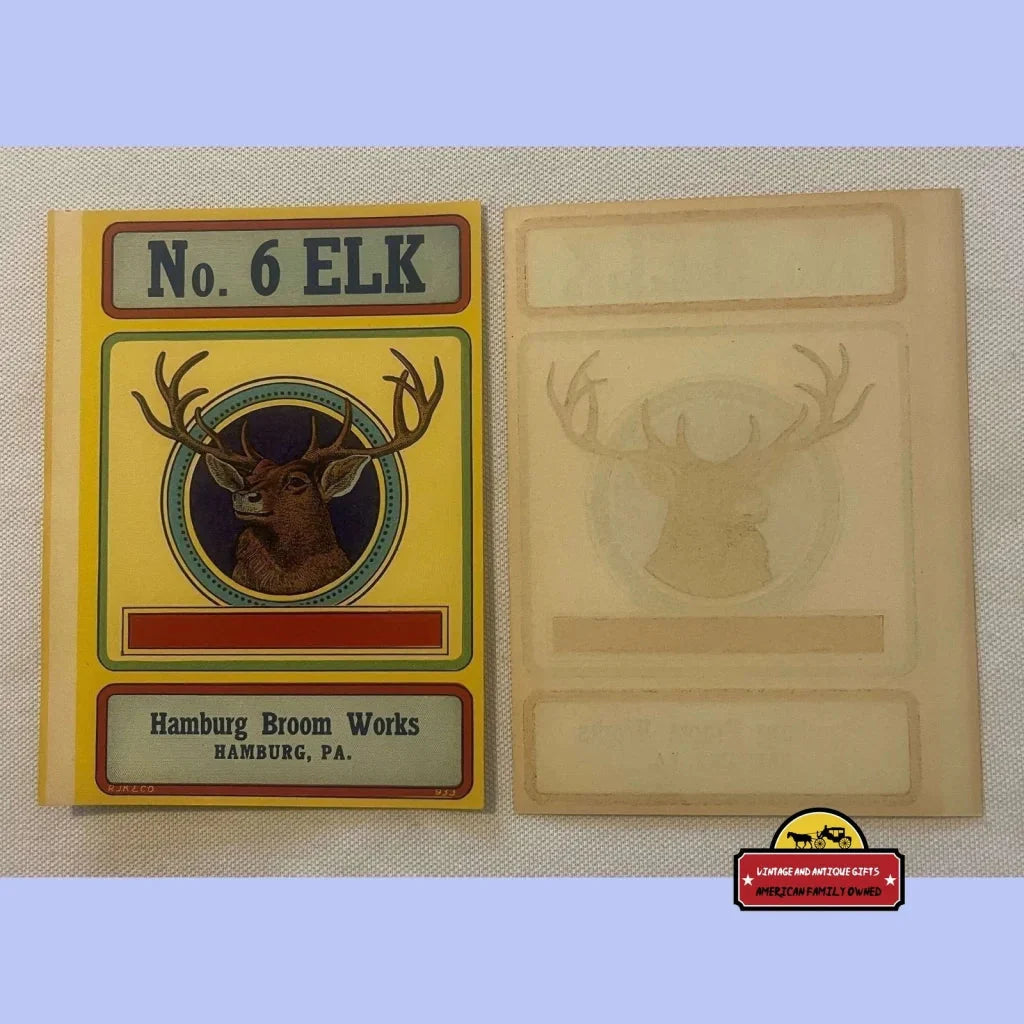
# What Did It Take to Print a Label This Beautiful — and Why Has No One Seen One Like This in Decades? 🦌 There is a particular kind of silence that falls over a collector when something genuinely rare lands in their hands. Not the silence of disappointment — the other kind. The held-breath kind. The *I didn't know this still existed* kind. That's what happens with this label. This is the **No. 6 ELK Broom Label from the Hamburg Broom Works of Hamburg, Pennsylvania** — a chromolithographic trade label printed somewhere in the window between the 1910s and 1930s, likely the early-to-mid 1920s, and never once applied to a broom. It has never met a warehouse shelf, never been dampened by humidity in a back-room storeroom, never had its corners clipped or its face scratched by a wire display rack. It exists today in **New Old Stock (NOS) condition**, exactly as it came off the printing press — colors holding with a clarity and saturation that stops you cold the moment you see it in person. The label measures **6 by 3.5 inches** — a generous, commanding size for a broom label of this era. The format is bold and confident: a wide yellow field, a deep navy blue circle medallion anchored at center, and rising out of that medallion, the head and full rack of a majestic elk — antlers spreading wide in every direction with the kind of swagger that only a chromolithographer working at the absolute peak of the craft could render in ink on paper. Red border bands frame the composition. Green accent lines sharpen it. Every element is intact. Every color is vivid. This is what **chromolithography** looked like when it was done right — when American printing houses were competing on quality and every manufacturer wanted a label that outshone the one on the shelf beside it. --- ## 🖨️ The Art Behind the Label — Chromolithography at Its American Peak To understand why this label looks the way it does, you have to understand what chromolithography actually *was* — not as a technical term, but as an industry, a craft tradition, and a genuine art form that shaped how Americans saw commercial goods for the better part of a century. Chromolithography — "chromo" printing — was the dominant color printing technology from roughly the 1860s through the 1930s, when photomechanical offset printing gradually displaced it. The process involved creating a separate hand-drawn or hand-transferred stone (later zinc plate) for each color in the design. A skilled chromolithographer might work with six, eight, ten, or more color passes to build up a single finished image. The registration had to be precise on every pass. The color mixing had to be planned well in advance of the final result, because each layer interacted with the layers beneath it. There was no preview, no undo. What you see on this label — the dimensional glow of that elk's fur, the way the navy medallion reads as almost luminous against the yellow field — those effects were the result of deliberate layering, of a craftsman thinking three or four color passes ahead. By the 1920s, American printing houses — particularly those serving the hardware, household goods, and agricultural implement trades — had refined chromolithography into a remarkably consistent commercial art form. Trade labels of this period are some of the finest examples of American graphic design that most people never think of *as* graphic design. They were functional objects. They were also beautiful. The ELK label is both. The bold, clean typography. The medallion format — a format used across dozens of broom brands and hundreds of trade goods of the era because it worked, because it read clearly from across a hardware store floor. The choice of the elk as a brand symbol, carrying exactly the right combination of American wilderness identity, strength, and pride. All of these were deliberate decisions made by someone — a designer, a company owner, a sales manager — who understood that a label was a sales tool and that beauty was part of the tool. --- ## 🏭 Hamburg, Pennsylvania — The Town That Swept the Country Hamburg, Pennsylvania is a small borough in Berks County, tucked along the Schuylkill River about fifteen miles north of Reading. If you drove through it today, you'd see a tidy, historic Main Street, some handsome 19th-century commercial buildings, and the unhurried pace of a Pennsylvania borough that has always known what it was. What you might not guess — what almost no one outside the trade remembers now — is that for a significant stretch of American industrial history, Hamburg was spoken of with genuine pride along the entire Eastern Seaboard as the **Broom Capital of the World**. That title was not marketing hyperbole. It was a descriptor earned through decades of production volume, trade relationships, and regional specialization that made Hamburg's name synonymous with quality brooms across the hardware and dry goods trades. The broom industry concentrated in Hamburg for the same reasons industries concentrated in specific American towns throughout the 19th and early 20th centuries: access to raw materials, access to rail, access to labor, and the momentum of reputation — once a town became known for a thing, the suppliers, the skilled workers, and the buyers all followed. **Wilson Schmick** founded the Hamburg Broom Works in 1894 at what would become 218 Pine Street. What Schmick built was not a cottage operation or a regional curiosity. It was a serious, sustained manufacturing enterprise — employing generations of local families, producing brooms by the millions, and moving product up and down the rail lines that connected the Schuylkill Valley to Philadelphia, New York, and the broader Eastern market. The Hamburg Broom Works operated in an era when American industrial towns produced with a pride of place that was inseparable from the product itself. The brooms were Hamburg brooms. That meant something. --- ## 🦌 The Elk — Symbol, Brand, and American Identity The choice to name a broom brand "ELK" — and to render that elk in full chromolithographic glory on every label — was not accidental, and it wasn't arbitrary. In the early 20th century, elk imagery carried a very specific set of associations in American commercial culture. The Benevolent and Protective Order of Elks, founded in 1868, had grown by the 1910s and 1920s into one of the largest and most influential fraternal organizations in the country, with lodges in virtually every American town of any size. Elk imagery was everywhere — on lodge buildings, on promotional materials, in local newspapers. A manufacturer who put an elk on his label was tapping into a network of association: brotherhood, community, local pride, American strength. He was also simply producing an image that American men of the period recognized and responded to positively. Beyond the fraternal angle, the elk as an animal symbol spoke directly to the American West and the romantic identity of the American wilderness — the same identity that drove the popularity of hunting prints, wildlife calendars, and the whole visual vocabulary of Theodore Roosevelt's America. An elk on a broom label said: *this product is strong, this company is proud, this is an American-made thing from people who stand behind it.* **Local legend among Hamburg collectors and regional historians holds that the No. 6 designation on this label referred not just to a product grade but to a specific broom size that Hamburg Broom Works marketed to hardware stores serving working farms and large households** — the heavy-duty end of the line, where durability and sweep width mattered most. Whether the numbering system ran from 1 to 6 or extended further is something the surviving trade catalogs and collector community have never fully resolved. What's clear is that the ELK label occupied a prominent position in the lineup, given the investment in artwork and the size of the label itself. --- ## 📍 Berks County, Pennsylvania — A Region That Built Things Berks County has always been a place that built things. Reading, the county seat, was a railroad town, an iron and steel town, a textile town — one of the great American industrial cities of the 19th century, now quietly reclaiming its own history. The smaller boroughs of the county, Hamburg among them, participated in that same tradition of manufacture and craft, each finding its own niche in the regional economy. The Schuylkill River valley that Hamburg sits in was a corridor of industry — coal moving south from the anthracite fields, goods moving north from Philadelphia, rail lines threading through gaps in the Blue Mountain ridge. The Hamburg Broom Works sat in that corridor and used it. Broomcorn — the tall sorghum variety that provided the fiber for brooms — came in from the Midwest, where it was cultivated at industrial scale. The finished brooms went out on rail cars to the hardware and dry goods distributors who supplied stores from Pennsylvania to New England. **Lore passed down among Berks County antique dealers holds that during the peak production years of the 1910s and 1920s, the Hamburg Broom Works ran multiple shifts and that the smell of broomcorn curing in the summer heat was a landmark scent of the town — something old-timers recalled decades later when asked what Hamburg smelled like when they were young.** Whether that's precise oral history or the kind of memory that softens and sweetens with time, it tells you something real about the scale of what was happening at 218 Pine Street. --- ## 🖼️ Display Ideas This label is frame-ready out of the envelope — NOS condition means no preparation required. Here are some of the finest ways collectors and decorators have used pieces like this: - 🪵 **Framed in a simple black or gilt frame on a sideboard or entry table** — the yellow ground and navy medallion read beautifully against wood tones, and at 6 x 3.5 inches, the label commands attention without overwhelming a small surface - 🏠 **Grouped with other Pennsylvania trade labels or Berks County ephemera** in a salon-style wall arrangement — chromolithographic labels from the same era share a visual language that makes them cohesive as a collection - 🦌 **Displayed alongside Elks Lodge memorabilia, hunting antiques, or wildlife-themed Americana** — the elk imagery bridges multiple collecting categories and works in rooms decorated around those themes - 🧹 **Featured in a broom and hearth tools display** in a kitchen, mudroom, or farmhouse-style keeping room — original trade labels paired with period tools create an installation that is both decorative and historically grounded - 🖼️ **Double-matted with a wide cream mat** to give the label breathing room and a museum-quality presentation that honors the artwork at its center - 🏷️ **Displayed unframed in an archival sleeve** as part of a flat ephemera collection, stored in a period map case or flat file alongside other NOS trade labels — the collector's approach, keeping the piece accessible and study-ready --- ## 🎁 Who Collects These The Hamburg Broom Works ELK label attracts a surprisingly wide range of collectors, which is part of what makes pieces like this so enduring in the ephemera market. **Pennsylvania history and regional Americana collectors** seek out any surviving material connected to Hamburg's industrial past — the Broom Capital story is compelling, and documented artifacts from Hamburg Broom Works are genuinely scarce. For a collector building a Berks County or Schuylkill Valley industrial history archive, this label is primary source material. **Trade label and advertising ephemera collectors** know that NOS chromolithographic labels from the 1910s–1930s are increasingly difficult to find in this condition. The combination of intact color, no applied damage, and a compelling central image — that elk head in full medallion — places this in the upper tier of what the category offers. **Elks Lodge and fraternal organization collectors** are drawn to the elk imagery and its cultural resonance. BPOE members with a collecting habit, or those who accumulate lodge-adjacent Americana, find that the ELK label fits naturally into a broader assemblage of elk-themed decorative antiques. **Farmhouse and vintage home decor enthusiasts** — the buyers who arrive at pieces like this through the decorating side rather than the collecting side — recognize immediately that a label this vivid and this graphic works beautifully in a framed display. The bold color palette translates perfectly to kitchen, mudroom, library, or den. **Wildlife and hunting antique collectors** who focus on elk, deer, and American game animal imagery find that chromolithographic trade labels offer an accessible and visually distinctive entry point — less expensive than carved decoys or bronze statuettes, more graphic and immediate than vintage prints. --- ## ❓ Frequently Asked Questions ### What exactly is "New Old Stock" condition, and what does it mean for this label? New Old Stock — NOS — is a term used across antique and vintage collecting to describe items that were manufactured for sale, never sold or used, and survived in original condition. For a paper trade label, NOS means this label was printed as part of a production run, stored in its original supply form (likely as part of a label bundle or sheet), and never applied to a broom, never exposed to adhesive on its back, and never subjected to the mechanical handling of a commercial application process. The colors you see are the colors as they came off the chromolithographic press. The paper is in its original uncompromised state. NOS condition is the highest condition grade for trade labels precisely because paper goods were designed to be consumed — applied, used, discarded. A survivor in NOS condition is the exception, not the rule. ### How vibrant are the colors really — do they photograph accurately? The short answer is that the colors photograph well but live even better. Chromolithographic inks from this period were formulated for visual impact at point of sale — these were not subtle, restrained designs. The yellow field is a strong, saturated golden-yellow. The navy medallion is deep and rich. The elk is rendered with enough tonal variation that the head and antlers have genuine dimensional presence. The red border bands are clean and saturated. In a frame on a wall or on a sideboard, the label reads with the same confident pop that made it effective as a commercial object a century ago. Buyers who have received pieces like this consistently remark on how vivid and undamaged the colors are — "pristine" is a word that comes up naturally, because it's accurate. ### Is this the kind of piece that should be framed under UV-protective glass? For any chromolithographic label you intend to display — as opposed to store flat in archival sleeves — UV-protective glazing is the right investment. The colors in this label have survived a century in storage because they were not exposed to light. Direct sunlight or even prolonged exposure to indoor light can, over decades, shift even the most stable period inks. A UV-filtering acrylic or glass front on a frame will protect that century of survival for the next century. Standard frames from most frame shops can be fitted with UV-protective glazing for a modest additional cost, and the label's 6 x 3.5-inch size fits within standard mat opening dimensions, making framing straightforward. ### What size frame should I buy for this label? At 6 by 3.5 inches, this label fits comfortably within a standard 5x7 mat opening if displayed edge-to-edge, or within an 8x10 frame with a generous double mat — the double mat approach is what serious ephemera collectors and frame shops recommend, as the mat breathing room around the label elevates the presentation significantly and prevents the label from appearing crowded. A wide cream or ivory inner mat with a darker outer mat — navy to echo the medallion, or black to anchor the composition — frames the label in a way that honors the graphic design at its center. Many buyers find that the label is ready to drop directly into a pre-made frame the moment it arrives. ### How rare is Hamburg Broom Works material in general? Genuinely scarce. The Hamburg Broom Works was a significant regional industrial operation, but like most American manufacturing businesses of its era, it did not generate the kind of corporate archive or museum-quality documentary record that large national brands sometimes left behind. Trade labels in particular were consumable objects — they were applied to brooms, the brooms were sold and used, the labels were destroyed in normal use. NOS survivors exist because someone, somewhere along the supply chain, held back a stock of unused labels rather than applying them. Those stocks surface occasionally in estate sales, in old warehouse lots, and in the collections of regional paper ephemera specialists. When they do surface in this condition, they tend to find homes quickly among collectors who understand what they represent. ### Can I tell exactly when this label was printed? The dating window of approximately 1910s–1930s — with the 1920s as the most likely decade — is based on the style of the chromolithographic printing, the graphic design conventions of the period, and what is known about the Hamburg Broom Works' operational history. Chromolithographic label printing in this style was characteristic of the peak commercial chromolithography era. The label design conventions — the medallion format, the bold field color, the typography style — are all consistent with the 1920s as a center point, though the label could have been printed slightly earlier or slightly later within that window. Precise dating of trade labels without surviving printer's records or catalog documentation is inherently approximate; the NOS condition confirms the label was never applied, but it does not by itself establish a precise print date. ### Does this label have anything on the back? As NOS printing stock, the back of this label is uncoated printing paper — there is no applied adhesive, no pre-gummed surface. Trade labels of this era were applied with paste or a separate adhesive at the factory, not pre-gummed like later pressure-sensitive labels. The back of the label is clean, unprinted paper, which is part of what makes the front so pristine — there has been nothing to cause moisture migration, adhesive bleed-through, or any of the other back-to-front deterioration that affects applied labels. For framing purposes, the label can be mounted with archival corners, archival photo corners, or a small amount of archival adhesive at the corners — all approaches that preserve the label's integrity and keep it removable if your display plans ever change.

Shipping

🚚 Shipping & Handling

  • Shipping costs and timing are calculated at checkout.
  • Items curated and shipped directly by me include U.S. shipping at no additional cost, professionally packed to ensure safe arrival of your artifact.

Items from Vetted Pro Collectors
Shipping for items offered by vetted Pro Collectors is determined at checkout. All Pro Collector listings are reviewed to ensure fair, reasonable shipping practices.

For full details, please refer to our Shipping Policy.

Returns & Exchange

Product Page Return Policy

  • 60-Day Returns – Items must be in original condition.
  • Refunds – Issued after inspection (excluding shipping costs).
  • Return Shipping – Customer is responsible unless item is damaged or incorrect.
  • Damaged/Incorrect Items – Contact us within 48 hours for a replacement or refund.
  • Easy Returns – Email [email protected] or call 802-356-9872 to initiate a return.

For full details, visit our Refund Policy.

View full details