Skip to product information
1 of 7

Vintage and Antique Gifts

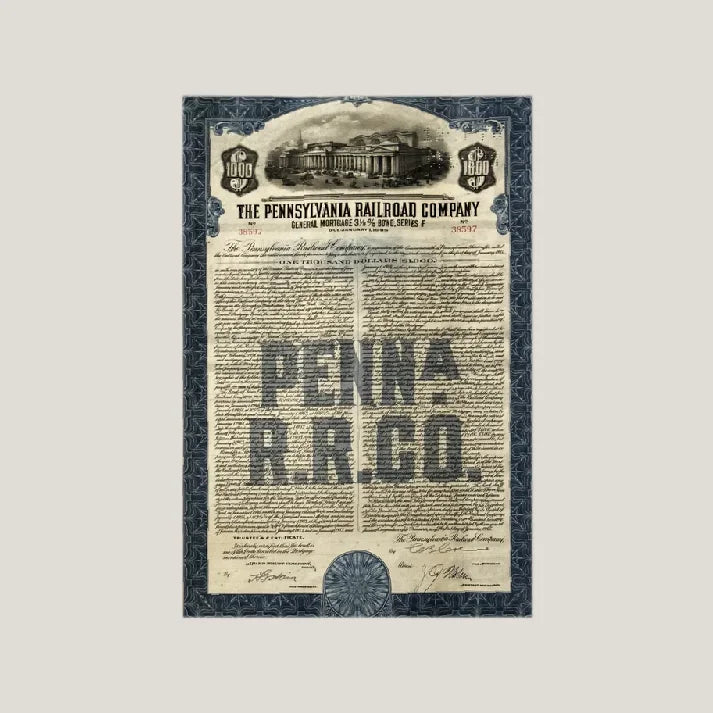
Vintage 1945 Pennsylvania Railroad Mortgage Bond Certificate 📜 Penn Station Vignette, Series F, Coupons

Regular price 16.00 USD
Regular price Sale price 16.00 USD
Sale Sold out
Shipping calculated at checkout.

Description

Ever Held a Piece of the "Standard Railroad of the World"? 🚂

There's a particular kind of quiet magic in an old railroad bond — thick, engraved paper that once represented real money, real trust, real steel rails laid across a continent. Long before interstate exit signs and airport terminals reshaped how Americans moved, the Pennsylvania Railroad — everyone who worked it or rode it just called it "the Pennsy" — was the artery of American industry. It moved coal out of the mountains, steel out of the mills, troops across the country in wartime, and businessmen and families between Philadelphia, New York, and Chicago on trains with names that became legend in their own right. Holding one of its bond certificates is a little like holding a folded piece of that vanished empire. This one still carries engraved interest coupons on its strip, still bears the ornate blue scrollwork borders and the solemn little vignette of a great train station across its top, and still carries the unmistakable weight and detail of cotton-rag security paper that made a corporate bond feel less like paperwork and more like a work of art.

This is a $1,000 General Mortgage 3⅛% Bond, Series F, issued by The Pennsylvania Railroad Company of Philadelphia, Pennsylvania, with principal and interest also payable through the railroad's office in the Borough of Manhattan, New York City. The printed text on the certificate itself notes the engraved facsimile signature of the company's Treasurer "as of the first day of January, 1945" — placing this piece's origin squarely in the closing months of the Second World War — with a stated maturity of January 1, 1985, giving the bond a full forty-year term. The certificate measures roughly 15 by 10 inches (about 38 x 25 cm) and is printed in the deep blues, blacks, and cream tones typical of American security engraving, framed in dense guilloche scrollwork borders meant to defeat counterfeiters, with the great arched vignette of Pennsylvania Station rendered in fine intaglio detail at the top center — automobiles, trolleys, and pedestrians frozen mid-stride in front of its towering Doric colonnade. A large diagonal PENNA R.R. protective overprint runs across the face of the document, and a small cluster of cancellation perforations sits near the vignette — the marks of a bond that was issued, paid on for years, and finally retired. Attached along the side is the printed strip of semi-annual interest coupons, dated January and July and running toward the 1985 maturity date. The earlier ones were clipped and cashed as the interest came due, which is exactly what a bond that was working for its holder looks like.


🏛️ The Vignette: Pennsylvania Station Before It Vanished

The building engraved across the top of this bond is Pennsylvania Station — the original one, the one that no longer exists. Opened in 1910 and designed by the celebrated architectural firm McKim, Mead & White, Penn Station was modeled after the Roman Baths of Caracalla, with a soaring waiting room of pink granite and pale travertine, a colonnade of Doric columns marching along Seventh Avenue, and a glass-and-steel concourse that let sunlight pour down onto the platforms below. It was, at the time, one of the largest and most architecturally ambitious buildings ever constructed in New York City, and it existed for one very specific engineering reason: the Pennsylvania Railroad had tunneled beneath both the Hudson and East Rivers so its trains could run directly into the heart of Manhattan for the first time, rather than terminating on the New Jersey shore and forcing passengers onto ferries. The station in the vignette on this bond, with its period automobiles and streetcars threading past the columns, captures the building at the height of its grandeur, in the decades before its fate turned.

By the early 1960s, with rail travel in decline and the railroad in financial distress, the Pennsylvania Railroad made the fateful decision to demolish the above-ground structure and sell the air rights, replacing the great Doric hall with Madison Square Garden and an office tower, while pushing the actual train platforms underground into cramped, low-ceilinged spaces. The demolition, carried out between 1963 and 1966, is still remembered as one of the great losses in American architectural history — the architectural historian Vincent Scully famously observed that one used to enter the city of New York like a god, and now scuttles in like a rat. The public outcry over the loss of Penn Station is widely credited with helping spur the passage of New York City's Landmarks Preservation Law in 1965, a law that would later save Grand Central Terminal from a nearly identical fate. Every surviving piece of paper engraved with the old station's likeness — bonds, stock certificates, timetables — is now one of the only physical windows left into a building that a generation of architects and preservationists still mourn.


🔑 The Pennsylvania Railroad: An Empire Built on Steel Rails

The Pennsylvania Railroad Company was chartered by the Pennsylvania state legislature on April 13, 1846, and it was born out of pure civic anxiety — Philadelphia's merchants watched the Baltimore & Ohio Railroad creeping toward Pittsburgh and feared that Baltimore would steal their port trade right out from under them. The legislature rushed the charter through, Samuel Vaughan Merrick took the reins as the company's first president in 1847, and construction pushed west through the Allegheny Mountains. By 1854 the line from Harrisburg to Pittsburgh was complete; three years later the Pennsylvania Railroad purchased the old state-owned Main Line of Public Works running east to Philadelphia, giving it, on paper, a through line from Philadelphia to Chicago. Under chief engineer and later president J. Edgar Thomson, the company grew relentlessly, absorbing smaller lines, extending west and south, and eventually operating one of the largest rail networks and largest corporations on the entire planet — at its peak, the Pennsylvania Railroad was frequently cited as the largest publicly traded corporation in the world by revenue, a scale almost unimaginable for a single company today.

The Pennsy adopted the keystone — the symbol of Pennsylvania itself, drawn from the state's own coat of arms — as its corporate emblem, stamped it onto locomotives and freight cars by the tens of thousands, and coined for itself the proud slogan "The Standard Railroad of the World," a phrase the company used for decades to describe its engineering, its punctuality, and its sheer scale of operation. Its flagship passenger train, the Broadway Limited, ran between New York and Chicago and became one of the most storied named trains in American railroading, competing directly with the New York Central's 20th Century Limited for the prestige of carrying the nation's business elite between its two greatest cities. The Pennsylvania Railroad's own engineering triumphs, like the famous Horseshoe Curve near Altoona, Pennsylvania — a sweeping loop of track that let trains climb the steep Allegheny grade — became so central to American industrial capacity that it earned a place in the nation's wartime anxieties as well.


⚔️ Steel Rails at War

This bond's printed date of January 1945 places its origin at the tail end of the Second World War, a period during which the Pennsylvania Railroad's tracks carried an almost unimaginable volume of troop trains, tank cars, and war materiel across the country. The railroad's importance to the national war effort was so well understood that Horseshoe Curve itself — the very engineering marvel that let PRR freight climb the Alleghenies — was reportedly named among the intended targets of a 1942 Nazi sabotage plot known as Operation Pastorius, in which German agents landed by U-boat on American shores intending to cripple key infrastructure. The plot was uncovered and its agents captured before any sabotage occurred, but the episode is still recalled by railroad historians as a measure of just how vital the Pennsylvania Railroad's lines had become to the nation's industrial and military capacity by the time bonds like this one were being printed and issued.


💵 What a General Mortgage Bond Actually Was

A railroad the size of the Pennsylvania Railroad required enormous, continuous capital to maintain its rolling stock, its bridges, its tunnels, and its terminals, and one of the primary tools it used to raise that capital was the general mortgage bond — a long-term corporate debt instrument secured by a mortgage against the railroad's actual physical property and franchises. This particular issue, Series F, was one of several lettered series the Pennsylvania Railroad brought to market over the decades under its general mortgage indenture, each with its own interest rate and maturity date reflecting the borrowing conditions of the moment it was issued. Series F carried an interest rate of 3⅛%, a modest rate reflective of the postwar financing climate, payable to the bondholder twice a year, every January 1st and July 1st, for the full forty years until the bond's maturity on January 1, 1985.

The mechanism for collecting that interest is the coupon strip still attached along this certificate's edge — in the era before electronic banking, a bearer bond like this one paid interest by literally having the holder clip off the dated coupon for that period and present it for payment, either at the Pennsylvania Railroad's own office in Philadelphia or at its agency in Manhattan. A bond that was actually put to work shows its coupon strip growing shorter year after year as each payment is collected, and that is the story this one tells: years of interest drawn down before the remainder was set aside. Standing behind the mortgage securing this and every other bond in the series was Girard Trust Company, named on the certificate as trustee, whose role was to certify that each bond issued truly was one of the instruments described and secured under the mortgage — the formal safeguard that gave bondholders confidence their investment was backed by something real.


🏦 Girard Trust Company of Philadelphia

Girard Trust Company, named on this certificate as the mortgage's trustee, was one of Philadelphia's most prominent financial institutions, taking its name from Stephen Girard, the early American merchant and banker whose fortune helped stabilize the young United States government's finances during the War of 1812 and whose estate later endowed Girard College. By the twentieth century, Girard Trust had become exactly the kind of established, conservative Philadelphia institution that a company as large as the Pennsylvania Railroad would entrust with certifying its mortgage bonds — a signal to investors, printed right on the face of this certificate, that the paper in their hands was genuinely secured.


🖋️ The Engraver's Art: American Bank Note Company

The certificate itself was produced by the American Bank Note Company, whose name appears in small engraved type along the border — the premier security printer of its era, trusted with printing currency, postage stamps, and stock and bond certificates for governments and corporations across the country. The dense, radiating guilloche patterns bordering this bond, the fine cross-hatched lettering, and the miniature detail of the Pennsylvania Station vignette itself are all hallmarks of the intaglio engraving tradition American Bank Note Company built its reputation on — a printing method using deeply cut steel plates that produced a raised, tactile texture on the finished paper, developed specifically because its fine detail was nearly impossible for counterfeiters to reproduce. Corporate bonds and stock certificates from this era were treated, quite literally, with the same engraving craftsmanship as paper currency, which is exactly why pieces like this one still carry such presence on paper more than a lifetime after they were printed.


🛤️ From Empire to Bankruptcy: What Became of the Pennsy

The Pennsylvania Railroad that issued this bond in 1945 would not see out the full forty years to its 1985 maturity as an independent company. In 1968, facing declining freight and passenger revenue as trucking and air travel drew traffic away from the rails, the Pennsylvania Railroad merged with its longtime rival, the New York Central, to form the Penn Central Transportation Company. The merger proved disastrous, and in 1970 Penn Central collapsed into what was, at the time, the largest corporate bankruptcy in American history — a shock that rippled through Wall Street and eventually led the federal government to intervene, creating Amtrak in 1971 to take over intercity passenger service and Conrail in 1976 to consolidate the freight operations of several bankrupt northeastern railroads, Penn Central among them. The name Pennsylvania Railroad, once synonymous with American industrial might, disappeared from the rails within a generation of this bond being printed — which is precisely why surviving paper like this, still bearing the company's full name, its keystone-era prestige, and its Penn Station vignette, carries the weight it does for collectors today.


🖼️ Display Ideas

  • 🚂 Framed as the centerpiece of a railroadiana or Americana wall alongside vintage timetables and locomotive photography
  • 🏙️ Paired with images or prints of the original Pennsylvania Station to tell the story of the building it depicts
  • 💼 Displayed in a home office or study as a conversation piece on American industrial and financial history
  • 🎁 Given as a meaningful gift for a family whose relative worked the rails, tying personal history to a national story
  • 📚 Placed alongside other scripophily and financial ephemera in a collection of American business history
  • 🗺️ Set beside a map of the Pennsylvania Railroad's historic routes for a Philadelphia-to-Chicago themed display

🎁 Who Collects These

Bonds and stock certificates like this one sit at the crossroads of several collecting worlds, and this piece speaks to nearly all of them at once. Scripophily collectors — those who specifically pursue historic financial documents for their engraving, their issuing companies, and their place in economic history — prize Pennsylvania Railroad paper as some of the most visually striking material in the entire field, thanks to the Penn Station vignette alone. Railroadiana enthusiasts and model railroad hobbyists collect Pennsy material specifically because the company's keystone logo and named trains remain legendary within the hobby. Fans of New York City architecture and preservation history seek out anything bearing an image of the original Penn Station, a building many of them never had the chance to see in person. And for many buyers, the appeal is much more personal — a piece like this makes a natural, meaningful gift for a parent, grandparent, or relative who spent a career working for a railroad, connecting a family's own working history to the sweep of a much larger American industrial story.


❓ FAQ

What exactly is this piece?

It's a $1,000 General Mortgage 3⅛% Bond, Series F, issued by The Pennsylvania Railroad Company, with a printed treasurer's signature dated January 1, 1945, and a maturity date of January 1, 1985. It includes its engraved coupon strip and bears the railroad's own diagonal PENNA R.R. protective overprint across the face.

Is this bond still redeemable for money?

No — this is a historic financial document collected for its history, artwork, and engraving craftsmanship, not a live financial instrument.

What building is shown in the vignette?

The original Pennsylvania Station in New York City, designed by McKim, Mead & White and opened in 1910, later demolished between 1963 and 1966 — one of the most mourned losses in American architectural history.

What does "General Mortgage" and "Series F" mean?

General mortgage bonds were long-term corporate debt secured by a mortgage against the railroad's own physical property and franchises. Series F was one of several lettered series the Pennsylvania Railroad issued under this mortgage program over the years, each with its own rate and maturity.

Why are some of the coupons missing from the strip?

Because the bond was working. Coupons were clipped and cashed year by year as the interest came due, which is exactly what a bond that paid its holder looks like.

Who was Girard Trust Company?

A prominent Philadelphia banking institution named for financier Stephen Girard, named on this certificate as the trustee responsible for certifying the mortgage securing the bond issue.

What happened to the Pennsylvania Railroad?

In 1968 it merged with the New York Central to form Penn Central, which collapsed into bankruptcy by 1970, eventually leading to the creation of Amtrak and Conrail — bringing an end to the independent Pennsylvania Railroad within a generation of this bond being printed.

These are issued instruments rather than blanks. Bonds and debentures of this type were registered to a holder, authenticated by the trustee, and punch- or cut-cancelled when they were finally redeemed. Expect financial writings, markings, stamps, hole punches and staple holes as part of the life of the instrument: endorsements and signatures, trustee and registrar stamps, revenue or documentary tax stamps, cancellation punches, staple holes from being bound into a transfer book, pencil ledger notations. That is the paper trail of a security that actually did its job, and it is what separates a document that lived from a blank that never did. No two are alike: holder details, serial numbers, dates, signatures, stamps and punch patterns vary from example to example, so the photographs show the type rather than the exact sheet that ships. The coupon count can run a few more or a few fewer than pictured.

Shipping

🚚 Shipping & Handling

  • Shipping costs and timing are calculated at checkout.
  • Items curated and shipped directly by me include U.S. shipping at no additional cost, professionally packed to ensure safe arrival of your artifact.

Items from Vetted Pro Collectors
Shipping for items offered by vetted Pro Collectors is determined at checkout. All Pro Collector listings are reviewed to ensure fair, reasonable shipping practices.

For full details, please refer to our Shipping Policy.

Returns & Exchange

Product Page Return Policy

  • 60-Day Returns – Items must be in original condition.
  • Refunds – Issued after inspection (excluding shipping costs).
  • Return Shipping – Customer is responsible unless item is damaged or incorrect.
  • Damaged/Incorrect Items – Contact us within 48 hours for a replacement or refund.
  • Easy Returns – Email [email protected] or call 802-356-9872 to initiate a return.

For full details, visit our Refund Policy.

View full details