Skip to product information
1 of 5

Vintage and Antique Gifts

Vintage Planters Mr. Peanut Cloth Sticker 🥜 1950s-1960s Halftone Print Patch

Regular price 8.00 USD
Regular price Sale price 8.00 USD
Sale Sold out
Shipping calculated at checkout.

Description

Do You Remember When Mr. Peanut Tipped His Hat on Every Corner Store Window? 🎩

There's a particular kind of magic in a face that everybody in America once knew on sight — no name needed, just the top hat, the monocle catching the light, the cane tucked jauntily under one arm. Long before "brand mascot" was a marketing term anybody used out loud, there was a dapper little gentleman peanut who did the job better than almost any character in advertising history ever has. Find one of these old cloth pieces tucked in a drawer, a scrapbook, or a box of grocer's leftovers, and you're not just holding a scrap of fabric — you're holding a sliver of the golden age of American advertising, back when a snack company could turn a nut into a genuine celebrity.

What This Piece Is

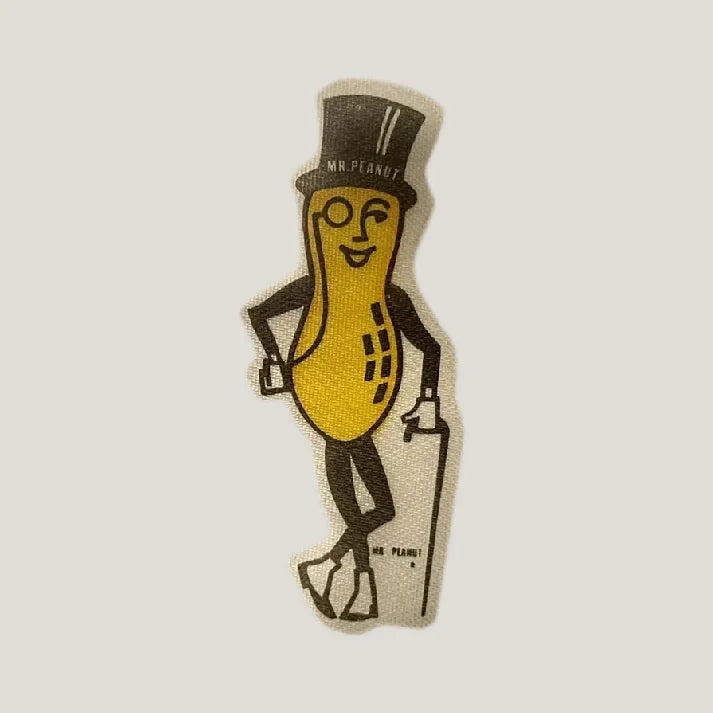
This is a vintage Planters Mr. Peanut cloth sticker — a small fabric advertising patch, measuring 2.5 x 1 inches (about 6.4 x 2.5 cm), printed with a halftone offset process directly onto woven cloth. That narrow, upright shape is no accident — it's built to trace the whole standing figure of Mr. Peanut top to toe, from the crown of his top hat down to his spatted feet, in one slim vertical strip. The palette is classic Planters: golden yellow for Mr. Peanut's shell-shaped body, deep black for his line work, top hat, gloves, and cane, and white for the open ground around him. Under the hatband, in plain block lettering, reads "MR. PEANUT" — the same signature that's identified this character for generations. Look closely and you can see the halftone dot pattern doing its work, especially in the shading along his suit — the same dot-screen color-separation printing that mid-century novelty and premium advertising items relied on before more sophisticated printing took over. This is New Old Stock — an original piece, never used, carrying the simplified line-art Mr. Peanut style associated with mid-20th-century Planters promotional material, from the era of the 1950s–1960s.

Mr. Peanut himself is rendered here in full character: top hat cocked at an angle, a round monocle fixed over one eye, an arched, knowing eyebrow above it, a warm open smile, one gloved hand resting on his hip, the other gripping the curved handle of his walking cane. Down the front of his shell you can see the little printed marks that suggest the segmented, cracked-open texture of a real peanut shell — a small design touch that's easy to miss and delightful to notice. Among the examples we've photographed, you'll notice one printed as a mirror image of the other — the whole figure, hat lettering included, flipped left to right. That's a genuine printing variation worth knowing about if you collect these, and it's part of what makes hunting down originals like this one so much fun.


🥜 The Immigrant Who Turned a Nut Into an Empire

The name printed on this little patch belongs to one of the great only-in-America business stories. Planters was founded in 1906 in Wilkes-Barre, Pennsylvania, by a young Italian immigrant named Amedeo Obici, and incorporated two years later as the Planters Nut and Chocolate Company. Obici had arrived in New York back in 1895 with nothing, working his way up as a bellhop and a fruit-stand vendor in nearby Scranton before he ever dreamed of building a peanut empire. He loved, as the company's own history puts it, "the way a handful of fresh-roasted peanuts could brighten people's day" — and he built an entire business on that simple idea.

Obici wasn't just a roaster; he was a born promoter, and one of the loveliest bits of company lore survives from his earliest days in business. To drum up sales, he devised a promotion where he'd slip one letter of his own last name — O, B, I, or C — into bags of peanuts, but only one "O" for every fifty bags sold. Whoever found that golden "O" walked away with a gold-colored Ingersoll watch, purchased by Obici himself for a single dollar. It's a small story, but it tells you everything about the man who built this brand: he understood, decades before "marketing" was even a proper discipline, that people love a little mystery and a little reward tucked inside their everyday purchases.


🎩 The Schoolboy Who Drew a Legend

Mr. Peanut himself — the very character smiling out from this cloth patch — has an origin story almost as good as Obici's own. In 1916, Planters ran a contest to design a proper trademark for the company. Among the entries was a sketch from a thirteen-year-old boy named Antonio Gentile, from Suffolk, Virginia, right in the heart of peanut country. His drawing showed a friendly, humanized peanut — arms, legs, a cane, personality to spare — and it won. Gentile's prize was five dollars, and for it, he earned a permanent, quiet footnote in American advertising history: the schoolboy whose sketch became one of the most recognized mascots the country has ever known. A commercial artist later refined that original schoolboy sketch into the more polished gentleman we know today, adding the monocle, the top hat, the spats, and the cane — but the spark, the character, traces back to a kid with a pencil in a Virginia schoolhouse.

Over the years, Mr. Peanut even acquired a proper backstory of his own: he's said to be of British heritage, and collectors and Planters enthusiasts alike have long enjoyed his invented full name — Bartholomew Richard Fitzgerald-Smythe. It's the kind of playful detail that only a mascot this beloved could earn — nobody bothers giving a fake full name to a character nobody loves.


🌾 Suffolk, Virginia — the Peanut Capital of the World

While Planters was born in Pennsylvania, its heart and its workforce belonged to Suffolk, Virginia. In 1913, Obici and his brother-in-law and business partner, Mario Peruzzi, moved the growing operation south to Suffolk, and the plant they built there grew into the largest peanut processing center in the world. Mention Suffolk to anyone who grew up there, even generations later, and the word "peanuts" comes up almost immediately — the town's whole identity became entwined with the crop and the company that processed it. Suffolk was already home to a cluster of peanut firms by the time Planters arrived — Columbian Peanut Company, Shoop-Withers, Holland and Lee, Tidewater Brokerage, Old Reliable, Pond Brothers among them — but it was Planters that did more than any single company to cement Suffolk's reputation as the "World's Largest Peanut Market."

Obici's ties to the town ran deeper than commerce alone — he went on to found Obici Hospital in Suffolk, a piece of civic legacy that locals still point to today. And local memory of the Planters plant itself runs remarkably deep and remarkably fond: when the old Planters structure was eventually taken down, hundreds of Suffolk residents turned out with cameras and lawn chairs as early as five in the morning just to watch it happen — a hometown send-off for a building that had shaped the town's economy and identity for the better part of a century. That's not the kind of send-off a company gets unless it truly became part of a place's soul.

The broader peanut industry that took root in Suffolk has its own documented pedigree — the Suffolk Peanut Company, formed back in 1898 by John Y. King and Colonel John B. Pinner, was eventually listed on the National Register of Historic Places in 2016 as a marker of that early twentieth-century industrial growth. Planters simply became the biggest name in a town that was already, by nature and by soil, built for peanuts.


🚗 From Times Square to the Open Road

By the 1930s, Mr. Peanut had graduated from a trademark into a full-blown cultural presence. Planters opened its own Planters Peanut Shoppes coast to coast, with especially famous locations right in the middle of Times Square and along the Atlantic City boardwalk — two of the loudest, brightest, most see-and-be-seen strips in the country, exactly where a gentleman-peanut mascot belonged. And in 1935, Mr. Peanut took to the road himself: the NUTmobile, his official peanut-shaped vehicle, first rolled out that year and has been a rolling advertisement, parade fixture, and roadside curiosity ever since. Picture the era this little cloth patch comes from — the five-and-dime counters, the soda fountain stools, the corner grocer's window — and you can picture exactly where a piece like this would have lived: pressed onto a jacket, tucked into a premium giveaway, handed out as a little piece of brand loyalty in an age when advertising still had genuine charm and personality behind it.


🏛️ Why Mr. Peanut Still Matters Today

Very few advertising mascots from the early twentieth century are still instantly recognizable more than a hundred years later — Mr. Peanut is one of the rare exceptions. Planters is today part of Hormel Foods, but the character born from a Virginia schoolboy's five-dollar sketch has genuinely outlived nearly every marketing trend that came after him, remaining one of the most enduring brand icons in American history. Holding a piece like this cloth sticker isn't just nostalgia for nostalgia's sake — it's a direct physical connection to a story that runs from an immigrant bellhop's fruit stand, through a small-town Virginia schoolroom, straight into the collective memory of an entire country's snack aisle.


🖼️ Display Ideas

  • 🎩 Frame it solo in a small shadow box to let that slim, standing silhouette of Mr. Peanut take center stage on its own.
  • 🥜 Pair it alongside other Planters advertising pieces — tins, banks, or premiums — for a mini mascot-history display.
  • 📌 Mount it in a vintage advertising or Americana collage next to other mid-century grocery and five-and-dime ephemera.
  • 🏠 Tuck it into a kitchen nook or pantry shelf display for a playful, nostalgic nod to snack-food history.
  • 📖 Slip it into a themed scrapbook or archive page dedicated to vintage American mascots and advertising icons.
  • 🎁 Give it as a small, story-rich gift to a fellow collector who already loves Mr. Peanut and everything he represents.

🎁 Who Collects These

Planters and Mr. Peanut collectibles sit in a category all their own — beloved by advertising and Americana collectors, by longtime Planters and peanut-industry enthusiasts, by anyone chasing mid-century grocery and five-and-dime ephemera, and by folks who simply grew up with that top-hatted gentleman on every jar and tin in the pantry. Cloth premiums and patches like this one appeal especially to collectors who like a piece that's genuinely wearable history — small, graphic, portable pieces of a mascot's long visual evolution. As one recent collector put it after adding a Mr. Peanut piece to their own collection, he "looks amazing" and it's remarkable he's "made it these years and still looking fabulous" — sentiments that echo exactly why this character has held onto so many hearts for so long.


❓ FAQ

What exactly is this piece?
It's a Planters Mr. Peanut cloth sticker/patch, printed with a halftone offset process directly onto woven fabric, measuring 2.5 x 1 inches.

How old is it?
The simplified line-art style and halftone dot color printing on cloth are consistent with mid-century Planters novelty and promotional items from the 1950s–1960s.

Is this new old stock?
Yes — this is New Old Stock (NOS), an original piece that was never put into use.

Why does Mr. Peanut wear a monocle, top hat, and carry a cane?
That formal, gentlemanly look has been part of Mr. Peanut's design since his creation, refined from an original 1916 contest-winning sketch by a young Suffolk, Virginia schoolboy named Antonio Gentile.

Why do some of these pieces look mirror-reversed?
Among originals like this one, you'll find copies where the entire figure and lettering are printed as a flipped, mirror-image version — a genuine printing variation from the era rather than a flaw.

Where was Planters based?
Planters was founded in Wilkes-Barre, Pennsylvania, in 1906, then moved its major processing operations to Suffolk, Virginia, in 1913, where it became known as the world's largest peanut processing center.

Who created the Mr. Peanut character?
A thirteen-year-old boy, Antonio Gentile of Suffolk, Virginia, sketched the winning design in a 1916 company contest and earned five dollars for it — a design later refined by a commercial artist into the polished gentleman seen here.

Shipping

🚚 Shipping & Handling

  • Shipping costs and timing are calculated at checkout.
  • Items curated and shipped directly by me include U.S. shipping at no additional cost, professionally packed to ensure safe arrival of your artifact.

Items from Vetted Pro Collectors
Shipping for items offered by vetted Pro Collectors is determined at checkout. All Pro Collector listings are reviewed to ensure fair, reasonable shipping practices.

For full details, please refer to our Shipping Policy.

Returns & Exchange

Product Page Return Policy

  • 60-Day Returns – Items must be in original condition.
  • Refunds – Issued after inspection (excluding shipping costs).
  • Return Shipping – Customer is responsible unless item is damaged or incorrect.
  • Damaged/Incorrect Items – Contact us within 48 hours for a replacement or refund.
  • Easy Returns – Email [email protected] or call 802-356-9872 to initiate a return.

For full details, visit our Refund Policy.

View full details