Skip to product information
1 of 7

Vintage and Antique Gifts

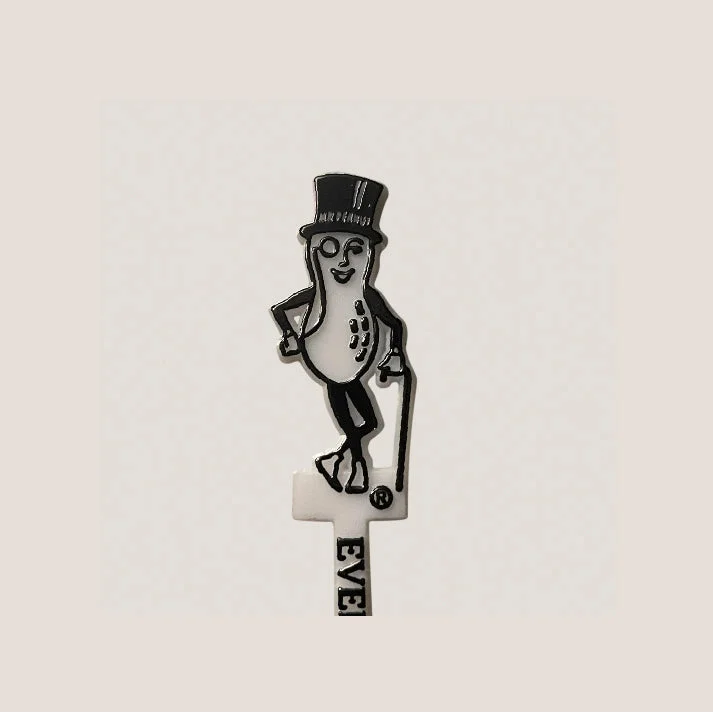
Vintage Mr. Peanut Swizzle Stick 🥜 NOS Planters "Everybody Loves a Nut" White Plastic Barware American Made

Regular price 8.00 USD
Regular price Sale price 8.00 USD
Sale Sold out
Shipping calculated at checkout.

Description

What Does a Six-Inch Piece of White Plastic Know About America? 🥜

More than you might expect. There is a particular kind of magic that lives in the smallest objects — the ones that were never meant to last, never meant to be saved, never meant to mean anything beyond a single evening at a bar or a backyard cookout or a mid-century cocktail party where someone's mother was serving highballs in her good glasses. And yet here it is. A swizzle stick. White plastic. Six inches long. Mr. Peanut on top, monocle glinting, top hat tilted just so, cane in hand, spats pressed and perfect — and running down the shaft in bold capital letters, that irresistible declaration: EVERYBODY LOVES A NUT. Somebody kept this. Decades passed. And now it's in your hands, or it's about to be, and somehow that feels exactly right.

This is what collecting is, at its best. Not the pursuit of the grand or the gilded. The pursuit of the thing that holds a whole world inside it, if you know how to look.

---

🥜 What It Is — The Object Itself

This is a genuine vintage New Old Stock (NOS) Mr. Peanut swizzle stick, produced by or for the Planters Nut and Chocolate Company as a piece of branded barware and promotional advertising. It measures six inches in length — a standard cocktail stirrer dimension for the era — and is molded from white plastic in the form of a long, slender shaft topped by the full-figured silhouette of Mr. Peanut himself: top hat, monocle, walking cane, spats, the whole dapper ensemble pressed cleanly and crisply from the mold. The front face carries black-and-white printed detail — Mr. Peanut's features rendered in the clean graphic shorthand that made him one of the most recognizable advertising figures in American commercial history. The shaft reads EVERYBODY LOVES A NUT. in bold capital lettering, with a trademark symbol riding just after the period — a small but significant detail that helps anchor this piece to a specific era of Planters' brand identity and legal formalization of the mark. The back of the stick is plain white, showing the clean reverse silhouette of the molded figure. New Old Stock means this piece was never put into regular circulation or use — it survived in unissued condition, which is precisely why it presents with the crispness and clarity that a used example from the same period simply would not. Finding NOS barware from this era is genuinely uncommon. Most of it was used, lost, thrown away, or forgotten. This one wasn't.


🎩 The Man With the Monocle — A Story Worth Telling in Full

The origin of Mr. Peanut is one of the great folk tales of American commercial art, and it deserves to be told properly every time it comes up — because it's the kind of story that almost sounds invented, and yet it isn't. In 1916, the Planters Nut and Chocolate Company held a contest to find a company mascot. The winner was a fourteen-year-old boy from Suffolk, Virginia, named Antonio Gentile. He submitted a drawing of a small peanut figure with arms, legs, and a cheerful face — a simple, charming little character with none of the refinement the brand would later add. He won five dollars for his trouble. Five dollars for the image that would go on to represent one of the most enduring food brands in American history. After the selection was made, a commercial artist — identified in most historical accounts as Andrew S. Wallach — took Gentile's straightforward schoolboy sketch and elevated it entirely. The monocle appeared. The silk top hat. The ivory-handled walking cane. The white spats over polished shoes. Suddenly the little peanut person wasn't just a mascot — he was a gentleman. He had a name. He had an identity. He had, in the parlance of the era, class. And in the class-conscious, aspiration-saturated consumer culture of early twentieth-century America, that meant everything. Planters wasn't just selling peanuts. They were selling the idea that even a humble legume could wear a top hat.

The phrase "Everybody Loves a Nut" — printed right there on this swizzle stick's shaft — is itself a piece of advertising history. It represents the brand's shift toward warmth, approachability, and wit. Planters understood, long before most consumer brands did, that humor was a form of trust-building. That a tagline with a wink in it was more memorable than one that simply announced a product's virtues. The trademark symbol on this piece is a meaningful detail for collectors and historians alike: it signals that the phrase was formally registered and protected, suggesting this item dates to a period when Planters was actively managing and formalizing its brand identity — the kind of institutional attention that mid-century brands gave their marks as advertising became professionalized and competitive.


🏭 Wilkes-Barre, Pennsylvania — Where the Company Began

The Planters Nut and Chocolate Company was founded in 1906 in Wilkes-Barre, Pennsylvania, by two Italian immigrants: Amedeo Obici, who would become the driving force behind the company's national expansion, and his partner Mario Peruzzi. Obici had arrived in America as a teenager and had been selling peanuts from a small cart in Scranton before he and Peruzzi formalized their partnership and incorporated the company. Wilkes-Barre, in the Wyoming Valley of northeastern Pennsylvania, was at that moment a city built on anthracite coal — a gritty, industrial, deeply working-class place, and a fitting birthplace for a company that was democratizing the snack. Peanuts were affordable. They were abundant. They were, in the parlance of the era, the people's nut. Obici understood this, and he built his entire brand philosophy around it. The genius of dressing Mr. Peanut in aristocratic clothing was the implicit joke at the heart of it — even the most humble, common snack could be presented with dignity and wit.

The company's manufacturing operations expanded significantly after the founding, and Planters eventually established major facilities in Suffolk, Virginia — a city in the Hampton Roads region that would become deeply associated with peanut processing and the Planters brand for much of the twentieth century. It is not incidental that young Antonio Gentile, the boy who drew the original Mr. Peanut sketch, was from Suffolk. The peanut economy and the Planters brand had saturated that region's identity so thoroughly that a schoolboy's doodle of a peanut man could win a national contest. Local legend in Suffolk has long held that the smell of roasting peanuts drifting from the Planters plant was as reliable a constant as the weather — that you could tell the direction of the wind by which part of town smelled most like a fresh jar being cracked open. Whether or not that specific romantic memory holds up to measurement, what is documented is that the plant was central to the Suffolk economy and identity for generations, and that the community's relationship with Planters was the kind of deep, woven-in connection that only comes from a major employer operating in a place for decades.

Lore passed down among barware and advertising collectors holds that swizzle sticks bearing the "Everybody Loves a Nut" phrase were distributed through a range of channels — promotional campaigns, hospitality accounts, trade shows — and that the NOS examples that surface today most often come from old bar-supply stock, hotel closets, or estate sales from families connected to the food service or hospitality industry. Whether any given surviving example came from a hotel bar in Pennsylvania or a supper club in Virginia or a promotional package sent to a corporate client in the Midwest, no one can say for certain. But the stories collectors attach to these pieces are as much a part of their value as the plastic itself.


📡 Mid-Century Barware Culture — The World This Stick Lived In

To understand what a Mr. Peanut swizzle stick meant in its own time, you have to understand the cocktail culture it was born into. The postwar decades in America saw an extraordinary expansion of home entertaining, bar culture, and the ritual of the cocktail hour. Branded barware — swizzle sticks, cocktail picks, stirrers, napkins, coasters — was a primary vehicle for corporate advertising in this environment. Food companies, airlines, hotels, spirit brands, and soft drink manufacturers all understood that a swizzle stick in a customer's hand was a tiny, intimate advertisement that traveled into homes and private spaces that a billboard or a radio spot never could. Planters, with its beloved and visually distinctive mascot, was exceptionally well-positioned to take advantage of this medium. Mr. Peanut on a swizzle stick is not just charming — it's strategic. It puts the brand's most recognizable visual asset directly into the hand of the consumer at the moment of leisure and pleasure. It associates the brand with hospitality, sophistication, and fun. The "Everybody Loves a Nut" tagline makes the drinker smile. The whole object is a masterclass in mid-century promotional thinking compressed into six inches of molded plastic.

The materials themselves are period-appropriate. White plastic in this era had a particular quality — a density and opacity that later plastics didn't always match, and a molding clarity that gave figures like this Mr. Peanut topper a crispness of detail that reads as craftsmanship even at swizzle-stick scale. The black-and-white printing on the face is clean and legible after all these years, which speaks both to the quality of the original production and to the conditions in which this NOS example was preserved. Time has been kind to this one.


🖼️ Display Ideas

  • 🍸 Vintage bar cart arrangement: Stand it upright in a small glass or cordial cup alongside other mid-century barware — cocktail picks, a swizzle stick holder, an ice bucket — for an assembled tableau that reads as both functional and decorative.
  • 🖼️ Shadow box or display frame: Mount it flat against a backing of period newspaper, a vintage Planters advertisement, or a piece of kraft paper alongside a printed card noting its history — perfect for a kitchen, bar room, or home office gallery wall.
  • 🥜 Planters collector's vignette: Pair with other Mr. Peanut ephemera — tins, jars, pins, or advertising prints — to create a focused brand history display that tells the story of one of America's most enduring mascots.
  • 🎩 Advertising art grouping: Group with other branded plastic or celluloid promotional items from the same era for a mid-century commercial art collection that highlights the design sensibilities of postwar American brand culture.
  • 🍹 Cocktail party conversation piece: Display it in the bar or on the entertaining table when hosting — it is, after all, exactly the context it was designed for, and it remains a guaranteed conversation starter seventy-plus years after it was made.
  • 🎁 Gift presentation display: Present it in a small glass cloche or a vintage apothecary jar for a gift that arrives looking like what it is — a curated, intentional, one-of-a-kind piece of American brand history.

🎁 Who Collects These

The collectors who seek out pieces like this Mr. Peanut swizzle stick are a particular and wonderful tribe. They tend to be people who understand that size is irrelevant to significance — that the most resonant objects in a collection are often the smallest, the most incidental-looking, the ones that required the most looking to find. Planters and Mr. Peanut collectors are among the most dedicated in the advertising and brand collectibles world. The mascot's longevity — more than a century of continuous use in one form or another — means that there are pieces from every decade, every medium, every application, and building a comprehensive collection is a genuinely absorbing long-term pursuit. Swizzle sticks occupy a specific and prized niche within that larger collecting world: they are ephemeral by design, which means NOS examples with full print clarity and undamaged figures are genuinely hard to source.

Beyond dedicated Planters collectors, this piece draws strongly from the barware and cocktail culture collecting community — people who focus on the material culture of mid-century entertaining and who value branded swizzle sticks, cocktail picks, and promotional barware as primary artifacts of that world. It also resonates deeply with Americana and advertising art collectors more broadly — people who see in a piece like this a distillation of postwar consumer culture, brand strategy, and graphic design thinking. And then there are the gift-givers: people who know someone who has "everything," who wants "something different," who will be genuinely delighted by a perfectly preserved piece of American history that costs less than dinner but carries more meaning than almost anything that could be purchased new. This is a gift for the person who lights up at the unexpected, the specific, the found — the person who will immediately know exactly what it is and exactly where to put it.


❓ Frequently Asked Questions

What does "New Old Stock" (NOS) mean for this swizzle stick?

New Old Stock — NOS — is a collecting term that describes items that were produced and kept in inventory but never put into active use or circulation. For a swizzle stick, this is a particularly meaningful designation. Barware of this type was typically used, washed (or not), lost, or discarded after a single season of cocktail service. An NOS example is one that survived in unissued condition — likely from a case or lot that was never opened, or from promotional stock that was set aside and simply never distributed. This is the reason this piece presents with the clarity and crispness it does: the printed face is clean, the molded figure retains its detail, and the plastic shows none of the wear or staining that characterizes used examples. NOS condition is genuinely uncommon in small promotional items like this, and it is one of the primary factors that makes this piece collectible at a level above a typical used example from the same era.

Is the "Everybody Loves a Nut" trademark symbol historically significant?

Yes, and it's a detail worth paying attention to. The presence of a trademark symbol following "EVERYBODY LOVES A NUT." on the shaft of this swizzle stick indicates that the phrase was formally registered and legally protected at the time of this item's production. This is a useful dating tool for collectors: it suggests the piece was made during a period when Planters was actively formalizing and protecting its brand language — a process associated with the professionalization of American advertising and intellectual property practice in the mid-twentieth century. For collectors of advertising ephemera, trademark symbols are like watermarks — they help locate a piece in time and in the context of a brand's institutional history. For display, upright in a small vessel — a cordial glass, a vintage swizzle stick holder, a small apothecary jar — works beautifully and keeps the figure visible. For storage, a clean archival sleeve or a small padded compartment in a collector's case is ideal. The printed face should be protected from abrasion, so avoid storing it loose with harder objects. Peanut collecting world?

Mr. Peanut is one of the most collected brand mascots in American advertising history, with a dedicated and knowledgeable collector community that has been active for decades. The breadth of Planters-branded merchandise produced over the company's history — tins, jars, figural banks, pins, buttons, plush figures, advertising prints, premiums, barware, and more — means there is collecting territory at every price point and in every medium. Swizzle sticks occupy an interesting position in this hierarchy: they are small, ephemeral, easy to display and store, and yet genuinely uncommon in NOS condition. They also represent a specific mid-century moment in the brand's history — the cocktail culture era, when branded barware was a primary advertising vehicle — that is distinct from the lunchbox tins and peanut butter jars that dominate other collecting categories. For a dedicated Mr. Peanut collector, this is a meaningful addition. For someone just beginning to explore the brand's material history, it's an ideal entry point.

Can you say more about Antonio Gentile, the boy who created Mr. Peanut?

Antonio Gentile was fourteen years old when he submitted his winning sketch to the 1916 Planters mascot contest. He was from Suffolk, Virginia — already the heart of peanut country — and his drawing was selected from a field of entries as the foundation for what would become one of the most recognizable commercial mascots in American history. He received five dollars as his prize. The commercial artist who elaborated on his design — adding the monocle, top hat, cane, and spats — transformed the sketch into the polished figure that appeared on everything from peanut tins to, eventually, swizzle sticks like this one. Gentile's contribution is frequently cited in the history of American advertising as a remarkable example of folk participation in commercial culture — a schoolboy's doodle, refined and elevated, becoming the face of a national brand for more than a century. Whether Gentile ever knew how thoroughly his five-dollar sketch would come to define an American institution is one of those small historical questions that no archive has fully answered.

Is this appropriate to actually use as a swizzle stick?

As a matter of pure function, yes — it was designed and manufactured to stir cocktails, and there is something genuinely delightful about using it for exactly that purpose. However, as a NOS collector's piece with full print integrity and an undamaged figure, most collectors would choose to display or preserve it rather than risk the wear that regular use would introduce. That decision is, of course, entirely yours. There is a certain school of thought in collecting that holds that objects designed to be used should be used — that a swizzle stick behind glass is a swizzle stick denied its destiny. And there is an equally valid school that holds that a piece this clean and this well-preserved deserves to be maintained. Both positions have their adherents, and this piece is magnificent either way.

What makes this a good gift for someone who isn't a dedicated collector?

The best gifts are the ones that feel specific — chosen, not generic. A piece like this succeeds as a gift precisely because it carries a story, a personality, and a wit that a mass-produced gift simply cannot replicate. The "Everybody Loves a Nut" tagline alone is a joy. Mr. Peanut in his full top-hatted glory is immediately recognizable to virtually any American over a certain age, and that recognition carries a warm charge of nostalgia that connects the recipient to their own memories — a jar of Planters on a grandmother's counter, a can of cocktail peanuts at a holiday party, the sight of that monocled gentleman on a thousand different packages across a lifetime of ordinary American moments. This swizzle stick is small enough to be unexpected and specific enough to feel genuinely considered. It is a gift that says: I found this, I thought of you, and I knew you'd understand exactly why.

Shipping

🚚 Shipping & Handling

  • Shipping costs and timing are calculated at checkout.
  • Items curated and shipped directly by me include U.S. shipping at no additional cost, professionally packed to ensure safe arrival of your artifact.

Items from Vetted Pro Collectors
Shipping for items offered by vetted Pro Collectors is determined at checkout. All Pro Collector listings are reviewed to ensure fair, reasonable shipping practices.

For full details, please refer to our Shipping Policy.

Returns & Exchange

Product Page Return Policy

  • 60-Day Returns – Items must be in original condition.
  • Refunds – Issued after inspection (excluding shipping costs).
  • Return Shipping – Customer is responsible unless item is damaged or incorrect.
  • Damaged/Incorrect Items – Contact us within 48 hours for a replacement or refund.
  • Easy Returns – Email [email protected] or call 802-356-9872 to initiate a return.

For full details, visit our Refund Policy.

View full details