
Skip to product information
1 of 14

Vintage and Antique Gifts

Vintage Planters Mr. Peanut Whistle 🥜 Figural Advertising Collectible Pair, Red & Gold Token

Regular price 14.00 USD
Regular price Sale price 14.00 USD
Sale Sold out
Shipping calculated at checkout.
Color

Description

🥜 Remember Reaching Into the Peanut Jar and Finding a Tiny Top-Hatted Man Waiting at the Bottom? 🎩

There's a very particular kind of memory that belongs to certain adults of a certain age — the smell of warm roasted peanuts drifting from a corner shop, a nickel pressed into a small palm, and a little prize tucked into the bag or handed over the counter as a thank-you for the purchase. Long before loyalty apps and punch cards, a company built its entire relationship with its customers on small, delightful surprises like this one. This pair of figural Mr. Peanut whistles — one in a deep, confident red, the other in a warm, burnished gold — is exactly that kind of surprise, preserved decades after it left the counter and never used.

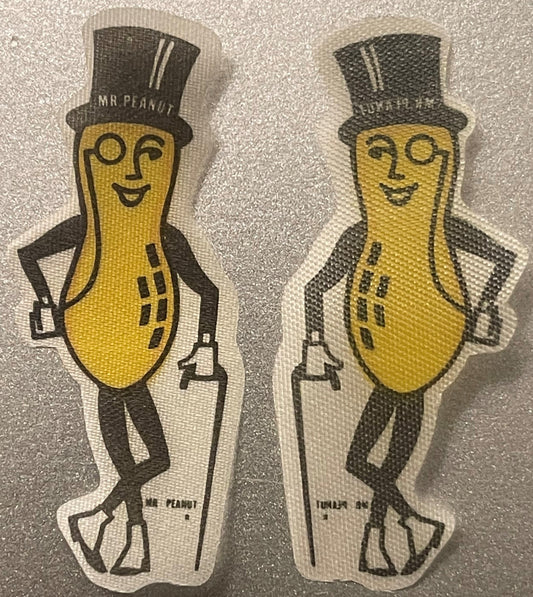
This is a Planters Peanut Company promotional figural whistle, cast in the unmistakable likeness of Mr. Peanut himself — top hat, cane, monocled gaze, and one hand cocked confidently at his hip, his shell-textured body rendered with the little bumps and ridges that make him instantly recognizable at a glance. The mouthpiece is built directly into the crown of his top hat, and blowing into it produces a sound that's less a sharp playground toot and more a sustained, rotating tone — which is exactly why collectors have argued for years over whether to call these little men "whistles" or "sirens." No manufacture mark on either piece was legible enough to pin to a precise year, so I'll tell you honestly what I can defend: these belong to that long, undated stretch of the early-to-mid twentieth century when Planters leaned hardest into small giveaway premiums — sometime after Mr. Peanut's own introduction in 1916 and running well into the decades that followed, the great era of the five-and-dime counter, the boardwalk arcade, and the penny giveaway. Each figure is true pocket scale, measuring just 0.5 x 1 inches — sized less like a shelf figure and more like a charm, a fob, or a prize you'd find rattling loose in a gumball machine, which is a large part of why so many of these vanished into pockets, junk drawers, and cigar boxes and were never seen again. What you're looking at here is New Old Stock (NOS) — genuine unused survivors of that era, never carried in a child's pocket, never blown on a boardwalk, simply held back and preserved.


🏭 A Roadside Peanut Stand That Became an American Institution

The story of Mr. Peanut cannot be told without the story of the man behind Planters, and it's a genuinely good one. Amedeo Obici arrived in the United States from northern Italy as a boy, and by his twenties he was roasting and selling peanuts from a small stand in Wilkes-Barre, Pennsylvania. He had a gift for showmanship — legend among old peanut-trade circles holds that he'd roast peanuts in the window of his shop specifically so the smell would pull foot traffic in off the street, a trick that plenty of popcorn and peanut vendors have quietly copied ever since. In 1906, Obici partnered with fellow Italian immigrant Mario Peruzzi, and together they founded the Planters Peanut Company, turning a corner-stand hustle into a national packaged-goods business almost overnight. Obici's genius wasn't just in the roasting — it was in the branding, the packaging, and eventually, in the character who would become one of the most recognized advertising mascots this country has ever produced.

🎩 The Schoolboy Sketch That Became a Legend

Here's the part of the story that collectors love to retell, because it's true and because it's the kind of thing that simply doesn't happen anymore. In 1916, Planters ran a public contest inviting anyone to submit a design for a company logo, offering a modest cash prize. Lore passed down among old-time collectors — and repeated so often in peanut-trade circles that it's become gospel — holds that the winning sketch came from a schoolboy in Suffolk, Virginia, a boy in his young teens who drew a simple, whimsical peanut man for the fun of it and walked away five dollars richer, no idea that his doodle was about to become immortal. A staff commercial artist took that boy's sketch and dressed it up for the boardroom: added the monocle for a touch of aristocratic charm, the top hat and cane for dignity, and the confident hand-on-hip stance that has never once changed in over a century of use. That's the character standing in front of you right now, cast small enough to fit in a coat pocket, exactly as generations of children first met him.

🚂 Suffolk, Virginia — The Peanut Capital of the World

Planters eventually built its great processing plant in Suffolk, Virginia, a small rail town that grew so entwined with the peanut trade that old-timers there still refer to it, with real pride, as the Peanut Capital of the World. Rail lines ran straight through the heart of the peanut belt of southeastern Virginia and northeastern North Carolina, and Suffolk sat right in the middle of it, drawing in wagonloads and later truckloads of raw peanuts to be roasted, salted, tinned, and shipped out across the country under the Planters name. The town's whole identity, for the better part of a century, was tied up in the peanut — its economy, its rail traffic, its very smell on a working day. A local peanut man in a top hat standing outside a Suffolk storefront wasn't an oddity; he was practically a neighbor.

😄 The Golden Age of the Giveaway

Mr. Peanut didn't just sell peanuts — he showed up. Planters dressed real people in oversized Mr. Peanut costumes and sent them walking through city streets and store aisles as living advertisements, a practice that old-timers recall drew genuine crowds of children trailing behind. Back at the counter, smaller premiums like this whistle did the quieter work: a little something pressed into a child's hand to make sure the peanut man came home with the family, not just the peanuts. This was the era of the five-and-dime store, the boardwalk arcade, and the drugstore soda counter, when a company's mascot lived as much in a child's pocket as on its packaging — a tin whistle, a pinback button, a tiny figural toy, each one a small piece of brand loyalty disguised as a plaything. It's worth pausing on the whistle's sound itself, because it's part of the character of the piece: rather than a crisp, single-note toot, blowing into the crown of the top hat produces a low, rotating tone, more siren than whistle, and it's a detail that has kept a good-natured, entirely unresolved debate alive among collectors for years over what to properly call it.

📺 An Icon That Outlived Its Own Century

What's remarkable about Mr. Peanut, looking back at him now, is how little he's changed. The top hat, the cane, the monocle, the confident stance — all of it was locked in by that original 1916 design, and it has proven so enduringly charming that the character has remained one of the most recognizable brand mascots in American advertising history, right alongside names like the Michelin Man and Colonel Sanders. Where most advertising mascots from that era have faded into total obscurity, Mr. Peanut has had genuine staying power in the popular imagination — which is exactly why small premium pieces like this whistle carry weight with today's collectors. They're not just old plastic; they're a physical artifact from the earliest chapters of one of the longest-running character-branding stories in American commercial history, back when a peanut company decided its mascot deserved a monocle.


🖼️ Display Ideas

  • 🥜 Line them up on a kitchen windowsill beside vintage tins and jars for an instant five-and-dime countertop feel.
  • 🎩 Tuck them into a curio cabinet alongside other early advertising mascots and figural premiums for a mini "American icons" shelf.
  • 🎪 Pair them with vintage carnival or arcade tokens to build a small tabletop vignette of boardwalk-era Americana.
  • 🖊️ Set one on a desk or bookshelf as a tiny conversation-starting sentry — the hand-on-hip pose practically demands to be noticed.
  • 🎁 Give the pair together to a Planters or advertising collector — red and gold side by side make a natural before-and-after color set.
  • 🏺 Display them in a shadow box with a bit of vintage Planters packaging or a peanut tin lid for context and color contrast.

🎁 Who Collects These

Mr. Peanut memorabilia sits at a genuine crossroads of collecting worlds, and that's part of what keeps demand for pieces like this one so steady. Advertising and brand-mascot collectors chase Mr. Peanut across every format he's ever appeared in — tins, banks, pins, salt shakers, and small figural premiums like this whistle. Whistle and premium collectors specifically hunt out early figural whistles as a category of their own, prizing the ones with real character sculpting over later flat or simple designs. Peanut and Planters brand loyalists — a surprisingly deep and organized community — treat any confirmed vintage Mr. Peanut piece as a cornerstone item. And plenty of buyers simply want a small, charming piece of nostalgia to gift a parent or grandparent who remembers Mr. Peanut from childhood, or a fellow collector who already has the tins and the banks but not yet the whistle.


❓ FAQ

Is this a genuine vintage Planters Mr. Peanut piece?

Yes — this is a Planters Peanut Company figural advertising whistle depicting Mr. Peanut, the company's mascot introduced in 1916. No manufacture date is legible on either piece, so I describe the era honestly as a wide range — the early-to-mid twentieth century, the great period of five-and-dime and counter-giveaway promotions — rather than pin it to a single unconfirmed year.

Does the whistle actually work?

The mouthpiece is built into the crown of the top hat, and the design produces a distinctive, sustained tone when blown — more of a rotating siren-like sound than a sharp single-note whistle, which is part of what makes this little premium so memorable.

What size is it?

Each figure measures 0.5 x 1 inches — genuinely pocket- and palm-sized, closer to a charm or a vending-prize scale than a display figurine, which is exactly how these traveled home in a child's pocket originally.

Why are there two colors — red and gold?

Both a deep red and a warm gold/yellow version of this figure are known to survive, and this listing offers the pair together so you can appreciate both color variants side by side.

Is this New Old Stock?

Yes — this pair is New Old Stock (NOS), meaning it's genuine unused old inventory that was never carried, used, or distributed at the time.

Who was Mr. Peanut named after, and does he have a real design history?

The character traces back to a design contest run by Planters in 1916, with lore holding that a schoolboy in Suffolk, Virginia submitted the original sketch, which a company artist later refined into the top-hatted, monocled, cane-carrying gentleman peanut recognized around the world today.

Is this a good gift for a collector?

Very much so — it combines figural advertising history, early character-branding lore, and genuine pocket-sized Americana into one small, conversation-starting piece, making it a natural fit for anyone who already collects Planters, advertising mascots, or vintage premiums.

Shipping

🚚 Shipping & Handling

  • Shipping costs and timing are calculated at checkout.
  • Items curated and shipped directly by me include U.S. shipping at no additional cost, professionally packed to ensure safe arrival of your artifact.

Items from Vetted Pro Collectors
Shipping for items offered by vetted Pro Collectors is determined at checkout. All Pro Collector listings are reviewed to ensure fair, reasonable shipping practices.

For full details, please refer to our Shipping Policy.

Returns & Exchange

Product Page Return Policy

  • 60-Day Returns – Items must be in original condition.
  • Refunds – Issued after inspection (excluding shipping costs).
  • Return Shipping – Customer is responsible unless item is damaged or incorrect.
  • Damaged/Incorrect Items – Contact us within 48 hours for a replacement or refund.
  • Easy Returns – Email [email protected] or call 802-356-9872 to initiate a return.

For full details, visit our Refund Policy.

View full details